DGN Insights | Zhou Jianhui: AI Diagnosis Has Become Standard in Dental Institutions, But Data Silos Remain Unconnected
 |
Editor's Note
Dental AI has been a hot topic for three years, yet a contradiction has been quietly accumulating in clinics—surgical guides are made precisely, but the prosthesis is misaligned during final restoration after implant placement. The reason is not complicated: from CT to Intraoral Scanning, facial scanning, and then to surgical guides, data from each device lives in isolated islands belonging to their respective manufacturers. Data from various manufacturers cannot be interconnected or transferred, and the systematic errors accumulate at each step of the precision workflow. Meanwhile, small and medium-sized clinics face another dilemma: not following the AI trend risks being left behind in the "arms race"; following it, however, may crush operating profits with the high cost of equipment investment. These two issues have been debated in the industry for a long time, but few can offer coordinated solutions from both the clinical and operational perspectives simultaneously.
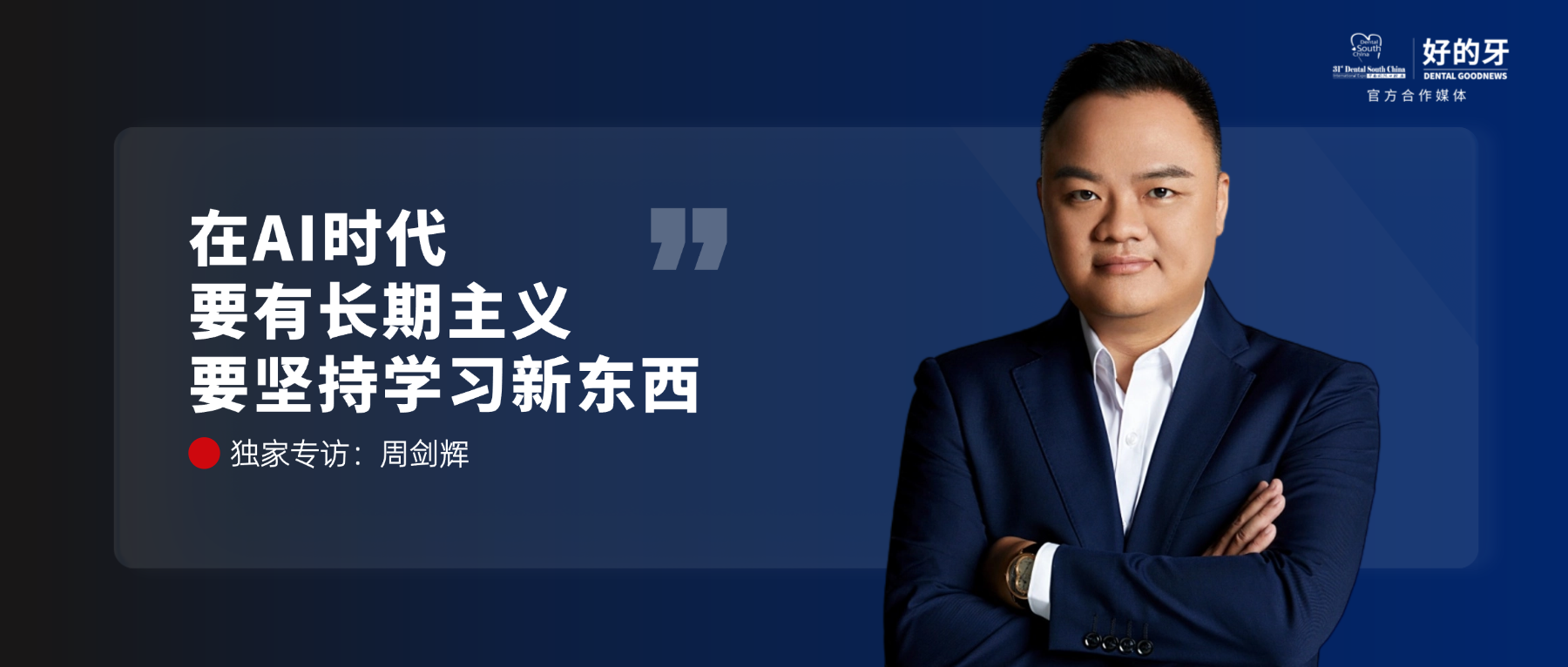
At the 31st Dental South China International Expo, DGN specially invited Mr. Zhou Jianhui—Founder and Chairman of Dongguan Charming Angel Dental, and Vice President of the Private Practice Branch of Guangdong Stomatological Association. With a clinical background and 20 years of medical practice, he later transitioned to dental management investment. Over the past 20 years, he has participated in investments and directly managed 30 dental hospitals and clinics. In this wave of AI, he is both a user of the tools and an operator who integrates them into the system. This dual perspective spanning clinical practice and management is quite rare in the industry.
This time, DGN delves into the industry's most genuine perplexities. We want to probe: with the penetration rate of AI diagnosis exceeding 90%, why are there still issues with implant precision? Where are the roots of data silos? Facing the AI wave, where are the respective paths for large/medium-sized clinics and small clinics?
The following:
DGN: The Dental South China International Expo is currently one of the largest professional platforms in the dental industry, with over 1,200 manufacturers showcasing here. Standing at the juncture of 2025-2026, what industry development trends have you observed?
Mr. Zhou Jianhui: The Dental South China International Expo 2026 has always been the most forward-looking and international dental exhibition in China. Even with global fluctuations in recent years, what I've seen is that the number of international teams participating each year hasn't decreased; instead, it has increased—I heard several teams from Indonesia came this year. This indicates that Chinese dentistry has become an unavoidable presence on the global map. Through the Belt and Road Initiative, China's representation in the dental landscape of Asia and even the world is growing stronger. The Dental South China International Expo 2026 is a microcosm of this trend.
DGN: In the specialized field of implantology, what new tools or products have you seen at the exhibition that can actually help clinics solve problems?
Mr. Zhou Jianhui: The most significant change is the leap from digitalization to AI diagnosis. Digital Equipment has been used in our clinics for several years, including Intraoral Scanning and facial scanning—but previous digitalization mostly provided an image, leaving data there. Substantive diagnosis still relied on the doctor's own judgment. Now it's different. AI diagnosis directly offers suggestions: design plans for precise guided implant surgery, recommended plans for orthodontic tooth alignment—these are already substantive diagnostic aids, not just tools.
DGN: What is the actual penetration rate of AI diagnosis in your clinics?
Mr. Zhou Jianhui: The overall use of Digital Equipment covers over 50% of the processes in our clinics. But for AI diagnosis—in scenarios like orthodontics and tooth alignment—the usage rate among young doctors in our clinics has already exceeded 90%. It's not because they feel their experience is insufficient, but because they think: why not take an extra look at the reference plans provided by AI based on massive global data? Young doctors may have limited accumulated experience, but by layering AI's data support, they can offer patients a more reliable plan. This, I think, is a major highlight this year—the real-world implementation of AI diagnosis.
DGN: What differences have you observed between experienced doctors and young doctors in using AI?
Mr. Zhou Jianhui: Experienced doctors use AI for reference and verification, comparing it against their own judgment; young doctors first use AI to generate a plan, then compare it with their own clinical reasoning—it's a process of learning by doing. Both paths lead to the same direction in terms of outcome: more inclusive diagnosis and greater patient reassurance. A 30-year-old doctor has limited clinical accumulation, but with global data support behind them, the patient's trust in the proposed plan is different.
DGN: At the management and operation level, what specific changes has AI brought to your clinics?
Mr. Zhou Jianhui: The most direct change is "cost reduction"—but not in the sense of layoffs, rather integration. We previously had three positions: front desk, patient education, and customer service. A patient would encounter four or five different faces in one visit. When they wanted to ask a small question, they often couldn't find the right person—doctors were busy, and the front desk didn't know the treatment details. Through AI agents, these three functions can be integrated: front-end and back-end information for the same patient is connected, providing continuous service.
At 11 or 12 PM, a patient might be anxious about post-extraction bleeding, but medical staff have rest hours and may not respond promptly. Through an AI agent, direct advice can be given to the patient, even scheduling an emergency visit at a nearby public hospital. This is a tangible service upgrade, not just a concept. Two key focuses we aim to implement this year: one centered on precision medical technology, and the other centered on patient comfort experience—these two things can truly be achieved with AI support.
DGN: You mentioned the upgrade path of clinic management software from SaaS to SRM to AI agents. How did this path unfold specifically?
Mr. Zhou Jianhui: Previously, clinic management software was mainly SaaS—it was just a data recording tool, informing you that something happened: a patient made an appointment, a follow-up is due. It didn't act; it only notified. Now it has moved to SRM, then to AI follow-ups, AI scheduling—the tools start to act proactively without human triggering. The next step is AI agents, integrating information from the former three positions (front desk, education, customer service), connecting front-end and back-end understanding of the same patient.
This upgrade path essentially involves three steps for tools: from "informing" to "executing" to "integrating." For us, each step reduces a layer of internal ineffective communication, reduces a layer of information asymmetry, and improves a layer of response timeliness for clients.
DGN: Did you encounter resistance when promoting AI applications? How did you address it specifically?
Mr. Zhou Jianhui: It's divided into two dimensions. On the medical side, the core is rapid training of young doctors, leveraging manufacturer training resources to help them master the AI usage workflow, then replicating it. For management and service positions, it's about matching the tools with existing processes—many AI tools are not perfect yet, and we are also providing feedback and refining them with manufacturers. AI has come too fast in the past two years, changing daily. Our attitude is: embrace it, but also provide clinical suggestions to manufacturers to make it more practical.
DGN: How do young doctors specifically use AI assistance for implant surgery? Can you give a concrete example?
Mr. Zhou Jianhui: Previously, when a young doctor performed a single-tooth implant, after completing CT, Intraoral Scanning, and facial scanning, they still needed to consult a senior implantologist—but the senior doctor's own daily schedule was full, and they might not respond promptly.
Now, using AI combined with multimodal data—CT images, soft tissue data from Intraoral Scanning—can inform the young doctor from multiple dimensions: what model of Dental Implant to choose, how deep to place it, at what angle to enter. Experienced doctors can do this by feel but can't clearly explain why. AI speaks with data. What young doctors learn is not just an outcome but also the underlying logic—this is the accumulation of true experiential value.
DGN: What role do you think AI plays on the patient side?
Mr. Zhou Jianhui: There's one application I find very interesting, called the "Smart Badge." By analyzing a patient's tone, speech rate, and focus points during the consultation, AI can judge the patient's personality traits and preferred communication style, suggesting to the doctor how to communicate more effectively. Additionally, when a patient comes for cleaning, AI can prompt based on their situation: what other potential needs they might have—teeth whitening, orthodontics, aesthetic restoration. Previously, doctors relied on intuition, wanting to initiate communication but unsure how to start or whether the patient had such needs. Now, with data support, it's much more precise.
DGN: You mentioned the scenario of "cleaning → orthodontics → whitening." How does AI help doctors initiate this conversation?
Mr. Zhou Jianhui: In the past, even if doctors intended to introduce treatments like orthodontics or whitening to patients, they often struggled with "not knowing how to bring it up": on one hand, it was difficult to judge whether the patient had corresponding needs or willingness; on the other hand, they were unsure what communication approach would increase patient acceptance.
Relying solely on personal experience for judgment was often not precise enough; if the patient had no such thoughts, bringing it up abruptly could easily make the conversation awkward. Now, through AI, combined with Smart Badge analysis and the patient's historical tags, it's possible to more accurately judge: whether this patient has the conditions, what their personality and acceptance style are, what timing is suitable for communication, and from what angle to approach it.
For the clinic, this is not only an improvement in service experience but also a path to increasing average customer spending—and it's data-driven, not sales pitching, just conveying the right information to the patient at the right time.
DGN: You repeatedly use "precision" to describe the value of AI. Can you elaborate on these two words?
Mr. Zhou Jianhui: Rather than saying AI is "assisting diagnosis and treatment," it's more accurate to say it's "enhancing precision." Empiricism has value, but it's personal, difficult to standardize and replicate. AI is data-driven, verifiable, and traceable—in this dimension, it's stronger than empiricism. This isn't about AI replacing doctors, but about adding a layer of data validation on top of the doctor's judgment, making the foundation of every decision more solid.
DGN: What products did you focus on at the Dental South China International Expo 2026?
Mr. Zhou Jianhui: What I really want to talk about is actually a systemic industry issue—data ports from different manufacturers are not open to each other. On the entire digital chain of implantology: CT, Intraoral Scanning, facial scanning, surgical guides, immediate restoration chairside printing, each device is good, but from different manufacturers, data is not interconnected, leading to cumulative errors. The surgical guide shows precision after being made; but after the implant is placed, the prosthesis is misaligned when fitted—because there's a data barrier in between, requiring manual data transfer between various systems, and errors arise here. I also hope that manufacturers or software companies in the industry can break this silo effect, because it genuinely affects clinical outcomes now.
DGN: You mentioned dynamic navigation and static surgical guides. What do you think are the core issues with each of these paths?
Mr. Zhou Jianhui: The issue with dynamic navigation is the real-time accuracy of data and the high skill requirements for the doctor—they need to know restoration and read real-time data; it's a problem of dynamic coordination. The issue with static surgical guides is that "restoration-oriented" planning is not done well—a frequent occurrence is: the guide is used, the implant is placed, but the prosthesis doesn't fit. The problems of both paths essentially point to the same thing: data is not interconnected; each link is optimized separately, leading to errors in the overall outcome.
DGN: Apart from digitalization and AI, were there any innovations in biomaterials or clinical techniques at this exhibition that left a deep impression on you?
Mr. Zhou Jianhui: I paid more attention to a technical direction that utilizes autologous tissue for periodontal tissue repair. This is a direction I find very valuable: it mechanically separates a transplant suspension from autologous soft tissue to repair one's own alveolar bone and soft tissue. In the past, during implant treatment, many doctors focused more on the implant itself, often overlooking the quality of the alveolar bone.
But whether an implant can be used stably for five or ten years is closely related to the condition of the alveolar bone. I believe these cutting-edge technologies surrounding alveolar bone and soft tissue repair have the potential to further enhance the long-term success rate of implant treatment—advances in basic materials and tissue engineering will ultimately be reflected in clinical outcomes.
DGN: Facing these new technologies, how can small and medium-sized independent clinics adapt? Is there still room for their survival?
Mr. Zhou Jianhui: This question is a bit poignant to discuss. Facial scanning, Intraoral Scanning, AI agents—most are concentrated in first- and second-tier cities; many clinics in other cities haven't even encountered them yet. Price is a real barrier—currently, the cost of these devices is still relatively high for private clinics. But the problem is, if you don't keep up, it's like not having weapons in an arms race; you'll eventually be passive. I also hope domestic manufacturers can lower prices, allowing clinics in third- and fourth-tier cities to access these cutting-edge technologies. This would benefit patients across China, not just those in big cities.
DGN: You mentioned "not having weapons means getting beaten, having them may crush operations"—is there a solution to this dilemma?
Mr. Zhou Jianhui: The solution is phased. First, let the most proactive people in the clinic master the tools and streamline the processes, then gradually replicate them within the team. Don't roll everything out at once; that would indeed crush operations. Furthermore, looking at the dental landscape in developed Asian regions, those that ultimately stand firm are precisely the "small but refined, small but beautiful" clinics, not the largest ones. This indicates that small and medium-sized clinics inherently have their value. The key, in the AI era, is to have a long-term perspective and not stop learning new things just because things are going well today.
DGN: What specific suggestions do you have for large/medium-sized clinics and small clinics respectively?
Mr. Zhou Jianhui: The biggest problem for large/medium-sized clinics now is homogenization—three large chains on one street, with similar services, advertisements, and prices. Patients ask: what makes you different from others? Scale is not the selling point; having specialized features within is the selling point.
My suggestion is, the larger the clinic, the more it should embrace cutting-edge technology and develop its own unique processes—"implants here are particularly precise," "orthodontics here are done very well"—this is the barrier for large clinics.
For small clinics, I call them "indestructible cockroaches"—resilient, low-cost, but they must have a long-term perspective. When large clinics are all using AI, if small clinics remain unaware, clients will gradually shift. Their strategy is not to engage in a war of attrition with large clinics but to overtake on the curve.
DGN: For your own chain of clinics, what is the direction for future scale?
Mr. Zhou Jianhui: In the future, we will control the area of our clinics to between 200 and 300 square meters. On one hand, stores of this size are easier to find and closer to communities; on the other hand, from a financial model perspective, this scale offers higher operational efficiency and a more reasonable service radius. I believe this model is a replicable direction for the future—not bigger is better, but more refined is better. This isn't to say large clinics have no value, but different strategies must ultimately land on "whether there is profit and whether it can be sustained."
Special Thanks
Special thanks to Mr. Zhou Jianhui for taking time out of his busy schedule during the 31st Dental South China International Expo 2026 to accept the exclusive interview with DGN, candidly sharing his in-depth observations and judgments on the implementation of AI diagnosis, digital data interoperability issues, and operational strategies for dental clinics of different scales. Thanks to the organizers of the Dental South China International Expo 2026 for providing venue support for this interview.
| About DGN:DentalGoodNews (DGN) is a trusted professional media platform dedicated to the global dental industry. We deliver in-depth coverage of corporate news, policy & regulation, investment & funding, and clinical frontiers — serving dental institutions, device manufacturers, investors, and industry researchers worldwide. Contact us: haodeya@dongxizixun.com |

;)