Exclusive Interview | President Wang Xing: Tear Down That "Medical-Engineering Wall"
 |
Editor's Note
Stomatology has a characteristic rarely seen in other clinical departments: almost all diagnosis and treatment behaviors are deeply bound to equipment, instruments, and materials. This means that every iteration in the industry directly impacts clinical practice; and every step of clinical progress also relies on timely follow-up from the industry. The 31st South China International Stomatological Exhibition is a cross-section for observing this relationship.
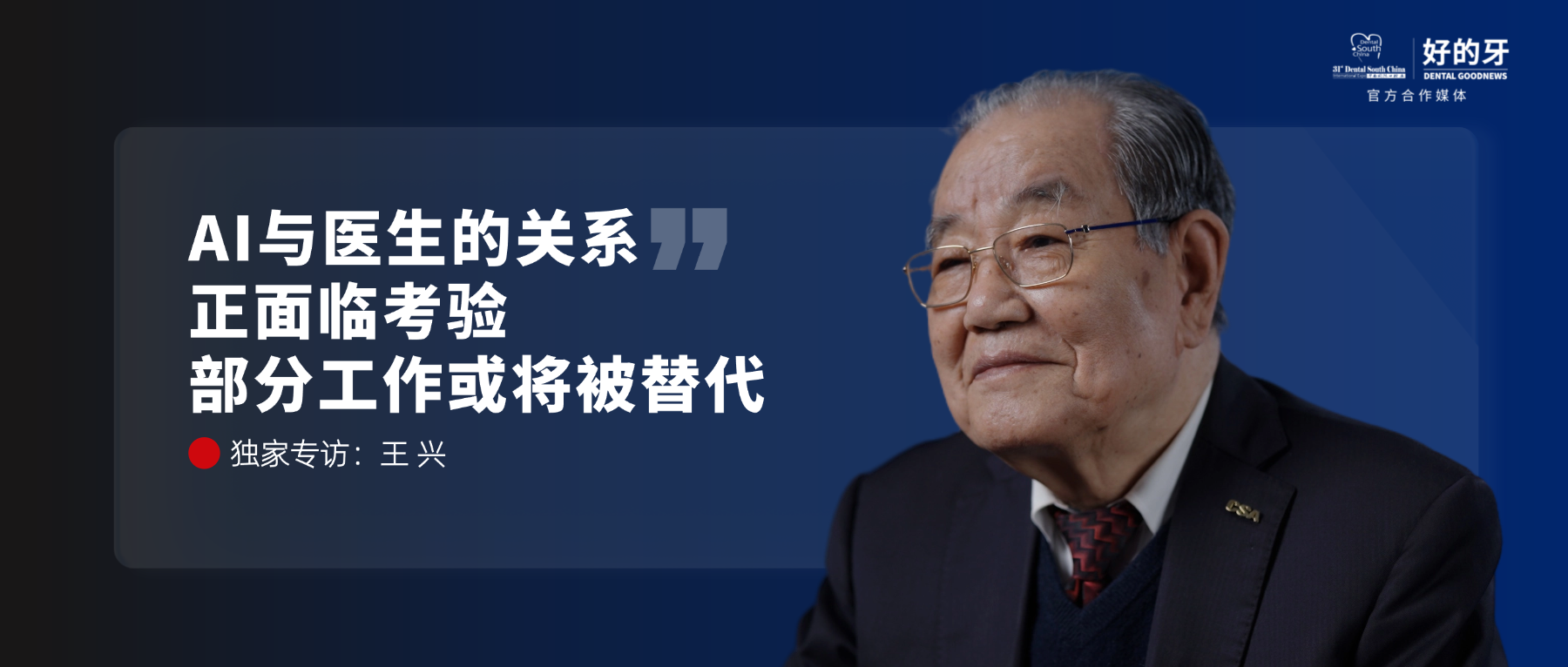
On March 3, 2026, DGN conducted an exclusive interview with Professor Wang Xing, Honorary President of the Chinese Stomatological Association (CSA), at the exhibition site. Professor Wang Xing presided over the Fourth National Oral Health Epidemiological Survey and initiated the "Oral Health Promotion Westward Journey" project during his tenure as President of CSA. He is an important participant in the development of Chinese stomatology over the past 30 years. In this interview, he discussed the significance of SCISE, the progress of China's industry, and the opportunities and challenges brought by AI and robotics.
For this interview, DGN specially invited Dr. Ge Qing—an attending physician in the Dental Implant Department of the Affiliated Stomatological Hospital of Guangzhou Medical University, specializing in digital guide implant and navigation-assisted technology—to serve as the special correspondent to conduct the on-site interview. The interview focused on three questions: the current international position of China's dental industry; what AI and implant robots mean for clinicians; and how the industry and the dental profession can truly form a synergistic force.
The following is the interview:
 |
Dr. Ge Qing: President Wang, the South China International Stomatological Exhibition welcomes its 31st edition this year. From your perspective, what noteworthy presentations are there at this year's exhibition?
President Wang Xing: Stomatology has a very distinct characteristic, different from other clinical work—it requires the use of a large amount of equipment, instruments, and materials. The development of all clinical disciplines in dentistry relies on the support of a series of instruments and materials. Without these, dentists can do nothing. Therefore, the development of stomatology has always been accompanied by the progress of dental medical equipment and materials.
The South China International Stomatological Exhibition has been held continuously for 31 years since 1995, without interruption even during the three-year pandemic. The South China region has special advantages—Guangzhou was one of the earliest established special economic zones, with relatively obvious policy and geographical advantages for exchanges with Southeast Asia, Hong Kong, Macao, and Taiwan. Against the backdrop of increasingly extensive international cooperation, many first-class dental instrument manufacturers from Europe and America also come to exhibit. Its scale is getting larger, and its level is getting higher—and this level, to some extent, reflects the overall progress of Chinese stomatology.
Dr. Ge Qing: You just mentioned "the level is getting higher." Could you elaborate on the current position of China's dental instruments and materials?
President Wang Xing: I can frankly say that, in terms of clinical level and the progress of dental instruments and materials, we have basically reached the international first-class level. Although we are not leading in every aspect, we can basically meet the needs of domestic stomatological clinical practice. What surprises me even more is that some domestic dental industry enterprises have already achieved the number one position in the global dental instrument and material market—this is not easy. We were very backward in the past, starting late, and it is only in the past two or three decades since the reform and opening-up that we have achieved rapid and remarkable development.
Dr. Ge Qing: What is your view on the development speed of the dental industry in Guangdong, especially the Foshan area?
President Wang Xing: Guangdong is a typical example. The Foshan area has positioned the dental industry as a leading and brand industry, with strong government support, leading to rapid development. Guangdong is also one of the fastest-developing regions in stomatology nationwide—at the undergraduate level alone, 11 institutions are cultivating stomatology talents, while also attracting a large number of high-end talents from across the country. With talent, equipment, and instruments, how could the dental cause in this region not develop rapidly? We now have so many well-known dental schools, making it one of the most densely concentrated regions in the country.
Dr. Ge Qing: This exhibition showcases many high-end equipment and new technologies. Which category are you most interested in personally?
President Wang Xing: Regarding the topic of dental medical equipment, my view is—you cannot say which is the most important because it is a series; lacking any one is not feasible. The most basic dental chair, which clinic can do without it? CBCT, which used to be a high-end demand, is now a basic requirement, needed by dental institutions across the country. There are also many seemingly minor things that are indispensable. The overall development of stomatology is inseparable from and progresses together with the development of the industry.
Dr. Ge Qing: You are saying "the progress of dentistry must go hand in hand with equipment"—
President Wang Xing: Yes, progress together. Equipment drives clinical practice, clinical practice raises demands, and the industry iterates—this is a cycle that cannot be viewed in isolation.
Dr. Ge Qing: AI is developing faster and faster now. Robotic systems have already appeared in the field of dental implants, and AI diagnosis is also advancing rapidly. How do you view the relationship between AI and human doctors?
President Wang Xing: This is an issue that requires our long-term consideration, but it is also an issue that requires a sense of crisis right now—because the development is too fast. Our country's dental implant robot, led by Academician Zhao Yimin in cooperation with Beihang University, is the first independently developed oral implant robot internationally, at the forefront.
But frankly speaking, this robot makes people of my age feel a bit unable to keep up and also a bit fearful. Why fearful? Which tasks of dentists will it replace? How should we handle our relationship with it? Should we see it as a helper or an adversary? Some say it is a new species—and the relationships between species have always been complex.
Dr. Ge Qing: You said "a bit fearful"—could you elaborate on this feeling?
President Wang Xing: I often discuss this with colleagues. I say, no matter how smart that robot is, if it stands in front of you in the middle of the night, I always feel a bit fearful. It might converse with you, issue commands to you, complete tasks very well—but the exchange of emotions, this point, is difficult to resolve. The conversation we are having now involves a flow of emotions. This humanistic care, this emotional connection, is still very difficult for robots to truly achieve.
So my hope is: as artificial intelligence continues to develop, we must continuously learn about it, master it, utilize it, to better enhance our service levels and care for our patients—rather than waiting to be completely replaced by it.
Dr. Ge Qing: In your opinion, which tasks of dentists will be replaced by AI first?
President Wang Xing: Some parts will be replaced; this is unavoidable. In terms of diagnosis—AI is smarter than us, takes less time, and may have higher accuracy; this part is likely to be replaced. Also, some relatively simple operational tasks; AI's efficiency will be much higher. Training a doctor is very laborious, but AI might solve it by spending money in a very short time—so this part indeed has the potential to be replaced.
But dentists being completely replaced? I believe in the fields of oral and maxillofacial surgery and stomatology, achieving complete replacement still has a certain distance. The oral cavity is a narrow, delicate environment requiring a large amount of fine manipulation, which AI cannot achieve all at once. But will it be completely replaced one day? According to some international predictions, it is possible—although this is hard for me to imagine, we must take it seriously. At this stage, we must learn about it, master it, and make it better serve dental medical care.
Dr. Ge Qing: So currently, we are still exploring this boundary?
President Wang Xing: Yes, we must wait and see. No one can give a definite answer now, but "we'll deal with it later" is no longer an option—this problem is right in front of us.
Dr. Ge Qing: For current technical personnel and young dental entrepreneurs, what suggestions do you have regarding the direction of equipment R&D?
President Wang Xing: The dental instrument industry is already applying a large amount of technology—digital production lines, automated assembly, large workshops with few workers visible, yet capable of producing extremely precise products with high efficiency and good quality. This aspect is not a problem.
But the link of dental clinical medical services is something all dentists must seriously value and actively learn. Do not become an outsider who understands nothing; that will inevitably lead to being eliminated in the future. Only by learning about it, mastering it, harnessing it, and combining with it to jointly serve patients is the way out.
Dr. Ge Qing: Do you think product R&D should also move more towards serving doctors' clinical operations?
President Wang Xing: Here lies a shortcoming in our country. Look at many international dental equipment and instruments; the initial ideas often come from dentists—they collaborate with manufacturers and businesses, continuously improving and perfecting, eventually launching various branded products. Some surgical instruments in oral and maxillofacial surgery are even named after the doctors who invented them.
The integration between our domestic industry and the dental profession is not yet sufficient. For example, China's dental implants were mostly developed by imitating foreign products in the past. There are still few new products deeply participated in by Chinese dental experts that reflect the unique clinical thinking of Chinese doctors. But I believe everyone will become increasingly aware of this, and such integration will become more and more—some dentists have already developed their own implants and launched them on the market, which is a good start.
Dr. Ge Qing: So you believe that technology inventors and clinicians perhaps need closer integration?
President Wang Xing: This is essential. The reason is simple: no matter how ingeniously you design it, if it cannot be used in the special environment of the oral cavity in clinical practice, then everything is empty. Therefore, we advocate that experts in the dental medical field and the dental industry must be closely integrated.
Dr. Ge Qing: Finally, what message would you like to send to those involved in product development and to clinicians?
President Wang Xing: They must focus—all research results should be promptly transformed into products with Chinese brand characteristics.
For example, there is a dental microscope enterprise in Suzhou. I have watched it grow from its start to today, and its market share in the international market is already number one—because it has developed its own characteristics in certain key parameters, making it more competitive than Leica, and it has gained a firm foothold in the international market. Many products like our country's Intraoral Scanning are also very popular in the international market now because of their good quality and price advantages, forming a significant competitive advantage against similar foreign products in the market. I believe such situations will definitely become more and more common in the future.
And for clinicians: especially experts, do not just bury your head in your own work, but integrate with the industry to translate your ideas into industry and product upgrades. In this regard, we still need to continue our efforts.
Dr. Ge Qing: President Wang, finally, could you talk about whether you personally have any particular focus on specific dental equipment or technological directions?
President Wang Xing: Frankly speaking, basically all products on the market now are things needed in clinical practice; it's hard for me to say I particularly favor one over another. More importantly, if the integration of medicine and engineering is done better in the future, we can launch more new things with Chinese characteristics. I look forward to seeing that day.
Special Thanks
Special thanks to President Wang Xing for accepting the exclusive interview from DGN during the busy schedule of the 31st South China International Stomatological Exhibition, and for candidly sharing profound insights on the progress of China's dental industry, the challenges of AI, and the integration of medicine and engineering. Thanks to Dr. Ge Qing for serving as DGN's special correspondent, completing the on-site interview and content co-creation. Thanks to the organizing committee of the 31st South China International Stomatological Exhibition for their strong support of this interview.
| About DGN:DentalGoodNews (DGN) is a trusted professional media platform dedicated to the global dental industry. We deliver in-depth coverage of corporate news, policy & regulation, investment & funding, and clinical frontiers — serving dental institutions, device manufacturers, investors, and industry researchers worldwide. Contact us: haodeya@dongxizixun.com |

;)