China's First Consensus on Neoadjuvant Immunotherapy for Oral Cancer Released
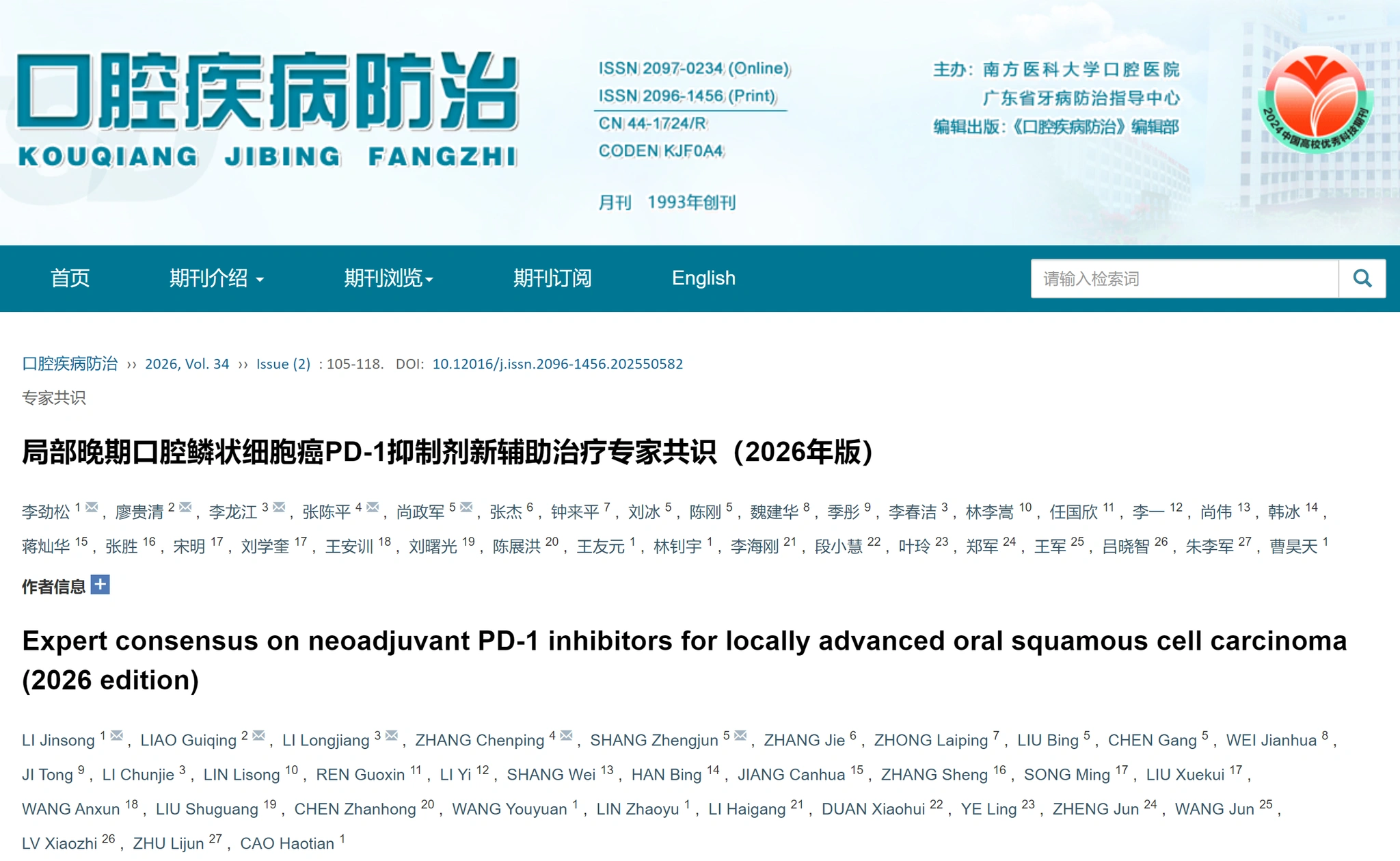 |
| Image source: Official website of "Journal of Prevention and Treatment for Stomatological Diseases" |
DentalGoodNews | In February 2026, the Journal of Prevention and Treatment for Stomatological Diseases officially published China's first Expert Consensus on Neoadjuvant PD-1 Inhibitor Therapy for Locally Advanced Oral Squamous Cell Carcinoma (2026 Edition) (hereinafter referred to as the "Consensus"). The Consensus was jointly developed by Professor Li Jinsong from Sun Yat-sen Memorial Hospital, Sun Yat-sen University, and other experts. It gathered 34 multidisciplinary experts from multiple hospitals across the country and formed consensus through anonymous Delphi voting, providing standardized clinical guidance for neoadjuvant immunotherapy for locally advanced oral squamous cell carcinoma in China.
The Consensus points out that oral squamous cell carcinoma (OSCC) is the most common malignant tumor in the head and neck region. Approximately 50% to 60% of patients are diagnosed at a locally advanced stage (III-IVa). Under the comprehensive sequential treatment model primarily based on surgery, the 5-year overall survival rate remains below 50%, and postoperative functional impairments such as speech and swallowing are common.
Against this background, the Consensus ultimately formed 13 recommendation statements (only those with an agreement rate ≥80% were included). Its core recommendation is: preoperative neoadjuvant therapy with PD-1 inhibitors can be used for patients with locally advanced OSCC (Evidence Level: I, Recommendation Grade: A). The preferred regimen is PD-1 inhibitor combined with platinum-based chemotherapy, with a recommended course of 2-3 cycles.
Regarding efficacy evaluation standards, the Consensus clearly states that imaging evaluation should follow the dual criteria of RECIST 1.1 and iRECIST. Systematic pathological evaluation of the primary lesion and regional lymph nodes should be conducted postoperatively. For combination chemotherapy regimens, PD-L1 expression and Combined Positive Score (CPS) are not used as inclusion or exclusion criteria. Existing clinical research supports the efficacy data for the above recommendations. A phase II prospective single-arm clinical study (n=82) showed that for resectable locally advanced OSCC patients receiving neoadjuvant therapy with tislelizumab combined with chemotherapy, the major pathological response (MPR) rate was 60.3%, and the pathological complete response (pCR) rate was 34.2%. After a median follow-up of 24 months, the 2-year overall survival (OS) rate was 84.4%, and the 2-year event-free survival (EFS) rate was 76.7%. The Consensus notes that another meta-analysis, which included 24 studies involving a total of 1092 head and neck squamous cell carcinoma (HNSCC) patients, showed that the objective response rate (ORR) for neoadjuvant PD-1/PD-L1 inhibitors combined with chemotherapy was 61%, higher than the 22% for single-agent immunotherapy.
Furthermore, the Consensus makes special provisions for specific populations: elderly patients (≥70 years old), HIV-infected individuals with stable viral loads, and chronic HBV/HCV carriers can cautiously receive immunotherapy under the assessment of a multidisciplinary team (MDT).
"Expert Consensus on Neoadjuvant PD-1 Inhibitor Therapy for Locally Advanced Oral Squamous Cell Carcinoma (2026 Edition)," Journal of Prevention and Treatment for Stomatological Diseases, 2026, Vol. 34, No. 2
As above, citing clinical research data (Full-text PDF of the paper)
China Clinical Guidelines Registration Platform
| About DGN:DentalGoodNews (DGN) is a trusted professional media platform dedicated to the global dental industry. We deliver in-depth coverage of corporate news, policy & regulation, investment & funding, and clinical frontiers — serving dental institutions, device manufacturers, investors, and industry researchers worldwide. Contact us: haodeya@dongxizixun.com |

;)