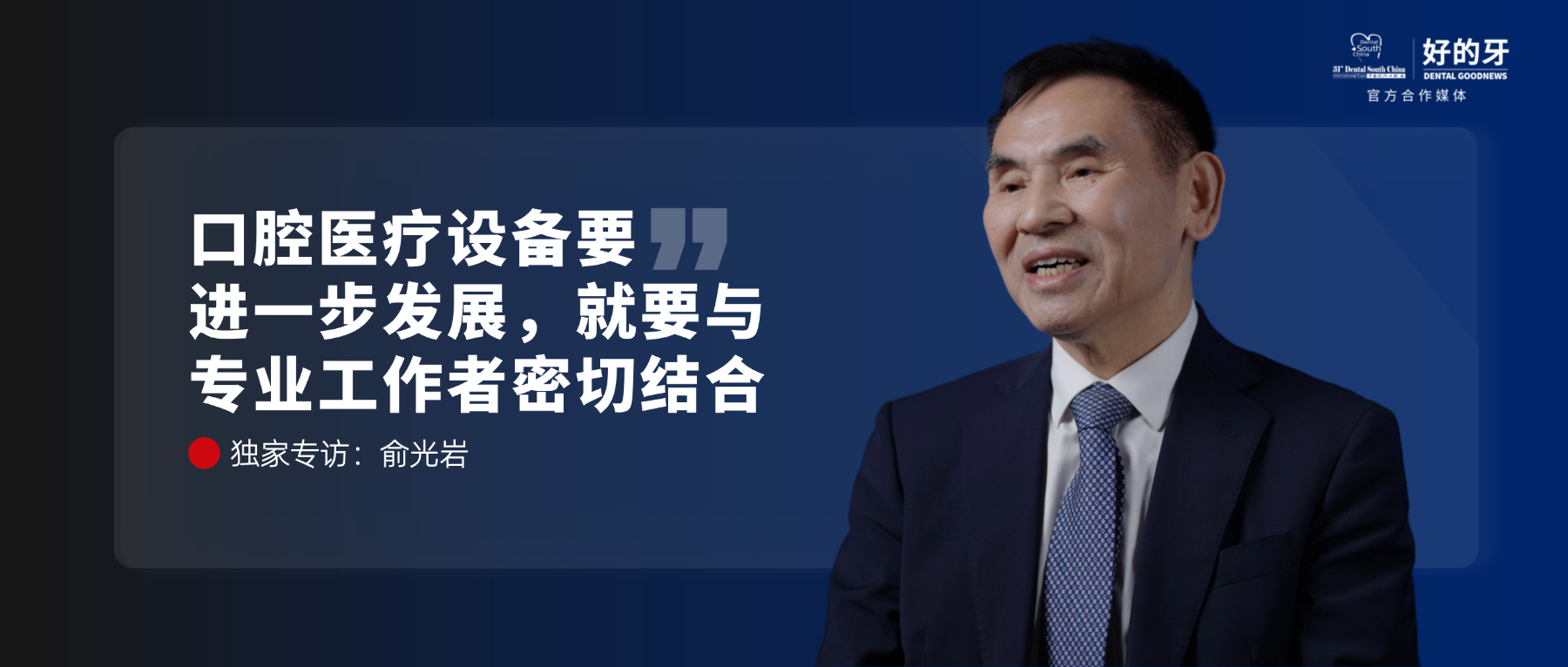
Exclusive Interview | Yu Guangyan: Innovation in Dental Instruments Requires Collaboration Between Medicine and Engineering, Small Tools Often Solve Big Problems
 |
Editor's Note
The dental equipment market is telling a new story: domestically produced is no longer "just making do," but rather "exporting to Southeast Asia." Cone Beam Computed Tomography (CBCT), dental chairs, dental operating microscopes—a number of domestic enterprises in these fields have completed the leap from import substitution to global export. However, the protagonists of this story are often described as capital, policy, or technological breakthroughs, overlooking the most crucial link.
March 3, 2026, at the DGN media room, 31st Dental South China International Expo 2026. Professor Yu Guangyan, Honorary President of the Chinese Stomatological Association and Professor at Peking University School of Stomatology—with over forty years of deep expertise in oral and maxillofacial surgery and salivary gland disease research, former Dean of Peking University School of Stomatology, and a long-term promoter of China's clinical and academic stomatology system—condensed his fundamental assessment of the industry's evolution over the past thirty years into this conversation.
This time, DGN Co-founder Mai Zijian engaged in a dialogue with Professor Yu on the innovation logic of China's dental equipment industry. We sought to explore: Where does the confidence for domestic equipment to go global truly come from? Why can a set of 11-piece tooth extraction tools become the sharpest lens through which to understand dental innovation? How can doctors' clinical insights truly be transformed into products, rather than remaining just ideas?
The following:
Mai Zijian: Professor Yu, you have a long-standing connection with the Dental South China International Expo. Could you first talk about when you started paying attention to and participating in it?
Professor Yu Guangyan: The Dental South China International Expo is now in its 31st year. It has played a very important role in promoting new technological products and driving industry development through conferences and exhibitions. I have been involved since its early days, basically attending every year, which should be over 20 years now. Over these years, the scale of the exhibition has continuously expanded, its content has become increasingly rich, and professional societies have also participated as partners. Therefore, the Dental South China International Expo is a very important platform for the dental industry and has played a significant role in the development of stomatology.
Mai Zijian: You once mentioned that "oral health is an indicator of a nation's level of civilization." What is the logic behind this statement?
Professor Yu Guangyan: Oral healthcare is considered a reflection and indicator of a nation's or an ethnic group's level of civilization—because if a country's people cannot eat their fill or dress warmly, oral healthcare is out of the question. Since China's reform and opening-up, basic livelihood issues have long been resolved. The public's awareness of oral healthcare has been continuously strengthening, and oral health behaviors are constantly improving. Therefore, oral health and hygiene are extremely important matters today.
Mai Zijian: What is the most prominent characteristic of the dental healthcare industry? What does this characteristic mean for equipment development?
Professor Yu Guangyan: The most prominent characteristic is the high proportion of procedural content. Tooth extraction, fillings, dental prosthetics—all require procedures, all require manual operation. This is different from internal medicine, which mainly involves prescribing and drug treatment. Our dental field has a much stronger procedural component. Therefore, dental healthcare is closely linked to instruments and equipment.
Mai Zijian: How do you view the overall development trajectory of China's dental equipment industry over the past few decades?
Professor Yu Guangyan: China's dental healthcare industry actually consists of two major parts—one is dental healthcare, practiced by medical personnel; the other is dental healthcare equipment and instruments. The two are inseparable and closely linked. The dental healthcare part has developed rapidly over the past few decades, especially in higher dental medical institutions and large dental medical organizations. Whether in terms of doctors' medical skill levels or specialization, it can be said to have reached international first-class standards. The equipment and instruments part started relatively late—in the 70s, 80s, and even 90s, it was basically dominated by imports.
Mai Zijian: When did this import-dominated situation begin to change?
Professor Yu Guangyan: Starting around the beginning of the 21st century, our domestic dental equipment enterprises achieved rapid development. Now, many dental medical devices are domestically produced, and their quality, whether in terms of appearance or level of intelligence, has reached a quite high standard. Two areas are particularly outstanding: one is CBCT. There are over ten domestic enterprises capable of producing CBCT, and the quality is quite good. The other is dental chairs, which are very feature-rich, and domestic ones are now quite excellent. They are not only widely used domestically but also exported in significant quantities—especially to Southeast Asian countries, where the proportion using our domestically produced CBCT and dental chairs is already quite high.
Mai Zijian: Speaking of dental chairs, what is your view on Foshan, Guangdong's industrial status in this field?
Professor Yu Guangyan: Foshan's production of dental chairs is very famous nationwide and even globally. In our country's foreign trade, Foshan, Guangdong's dental chair exports account for a quite high proportion.
Mai Zijian: How do you think domestic development is in the area of CBCT?
Professor Yu Guangyan: The CBCT quality from several domestic enterprises is quite good. Additionally, for some core components—like high-voltage generators—we in China can also achieve complete self-sufficiency.
Mai Zijian: You just mentioned the direction of microscopy. Specifically regarding microscopic endodontic treatment, how far have domestic devices progressed?
Professor Yu Guangyan: Endodontic treatment is a very important part of dental treatment. Nowadays, many adopt microscopic endodontic treatment—operating under a microscope, which greatly improves precision and significantly enhances medical quality. Domestic dental operating microscopes emerged relatively early, with high quality. They are quite commonly used domestically and hold a considerable market share both domestically and internationally. This is something we are very pleased to see.
Mai Zijian: Speaking of dental operating microscopes, we understand that some brands' engineering teams have deeply engaged with clinical practice, solving doctors' occupational health issues, and have developed 3D naked-eye microscopes, AI navigation, etc.—this is precisely the trinity of visualization, precision, and digitization you mentioned. Moreover, some products are already selling well globally. Such domestic brands have indeed emerged in the high-end equipment track.
Professor Yu Guangyan: Yes, indeed. Enterprises need to continuously improve and refine based on clinical needs; this direction is correct. The ability to occupy a considerable market share domestically and internationally is precisely because they have truly solved problems for clinical doctors.
Mai Zijian: Besides these specific segments, what do you think is the most core element driving the further development of the dental equipment industry?
Professor Yu Guangyan: A very important point for the further development of dental medical equipment is to closely integrate with dental professionals. In the dental medical profession, doctors know what products are needed. They can jointly conduct research and development, then apply the products clinically to test their advantages and identify shortcomings, allowing for continuous improvement. I believe that for a product to achieve broader promotion, the prerequisite is first gaining widespread use among dental professionals, ultimately expanding its influence in practical applications. Therefore, close cooperation between dental professionals and those involved in dental equipment and instruments is very important.
Mai Zijian: You mentioned "starting from clinical needs"—in dental clinical practice, what pain points currently remain inadequately addressed and could become directions for innovation?
Professor Yu Guangyan: In clinical practice, there are still many specific problems to be solved. However, as long as enterprises maintain close contact with dental professionals, they can continuously stimulate new ideas and innovative awareness from frontline diagnosis and treatment scenarios, ultimately promoting the landing of innovative products. For example, Professor Hu Kaijin from the Air Force Medical University—he is an oral and maxillofacial surgeon. During his clinical practice of tooth extraction, he continuously contemplated how to improve operational procedures and instrument design, thus proposing and designing various small instruments related to tooth extraction. His related ideas, after collaborating with enterprises, were ultimately transformed into a set of 11-piece clinical tooth extraction products. This can be said to be a relatively successful case of doctor-engineering integration.
Mai Zijian: Besides Professor Hu Kaijin's case, are there similar cases of doctor-engineering transformation?
Professor Yu Guangyan: Yes. For instance, Professor Yue Lin, Vice President and Secretary-General of the Chinese Stomatological Association, has a patented invention for a tongue retractor, which has been transferred to an enterprise and will enter the large-scale development stage. This patented item is very small but highly practical. It can effectively improve convenience during oral procedures and will lead to a relatively obvious improvement in treatment standards.
Mai Zijian: Looking at these two cases, what do you think is the core value of doctor-engineering integration?
Professor Yu Guangyan: I believe the core lies in the close cooperation between enterprises and professional dental doctors, applying the innovative ideas and clinical thinking of professional doctors to enterprise research and development. This way, everyone benefits—doctors' insights find an outlet for realization, and enterprises' products gain a foundation truly rooted in clinical practice. Ultimately, this is very necessary and helpful for improving our dental healthcare standards.
Mai Zijian: What you shared today is essentially a complete logic that starts from doctors' needs and then feeds back to more doctors—the two wings of stomatology collaborating, clinical insights transforming into solutions, small tools solving big problems. Are these directions also areas that practitioners in the industry who want to engage in innovation and entrepreneurship can deeply explore?
Professor Yu Guangyan: Yes, that's exactly the reasoning. The experience and problems accumulated by professional doctors in clinical practice, combined with enterprise research and development, can produce good products, which greatly promotes the development of the industry.
Special Thanks
Special thanks to Professor Yu Guangyan for taking time out of his busy schedule during the 31st Dental South China International Expo to accept this exclusive interview, sharing his firsthand judgment and forward-looking observations on the thirty-year evolution of China's dental equipment industry. Thanks to the 31st Dental South China International Expo for its support and facilitation of this interview.
| About DGN:DentalGoodNews (DGN) is a trusted professional media platform dedicated to the global dental industry. We deliver in-depth coverage of corporate news, policy & regulation, investment & funding, and clinical frontiers — serving dental institutions, device manufacturers, investors, and industry researchers worldwide. Contact us: haodeya@dongxizixun.com |

;)