The 30,000 Yuan Red Line is Set: The End of "Commission-Driven Sales" in the Dental Industry
 |
A judicial interpretation has turned the previously ambiguous area of "commission-based sales" in oral equipment into a clear criminal red line. This is not the invention of a "new crime," but a precise calibration of law enforcement—for clinic owners, Consumables distributors, and brand owners, it means the rules of the game have quietly changed.
The Real Signal Behind the Frenzy
On April 10, 2026, the Supreme People's Court and the Supreme People's Procuratorate jointly issued the "Interpretation (II) on Several Issues Concerning the Application of Law in Handling Criminal Cases of Graft and Bribery" (hereinafter referred to as "Interpretation II"), which will take effect on May 1. Once the news broke, the topic of "criminalizing medical kickbacks" quickly went viral.
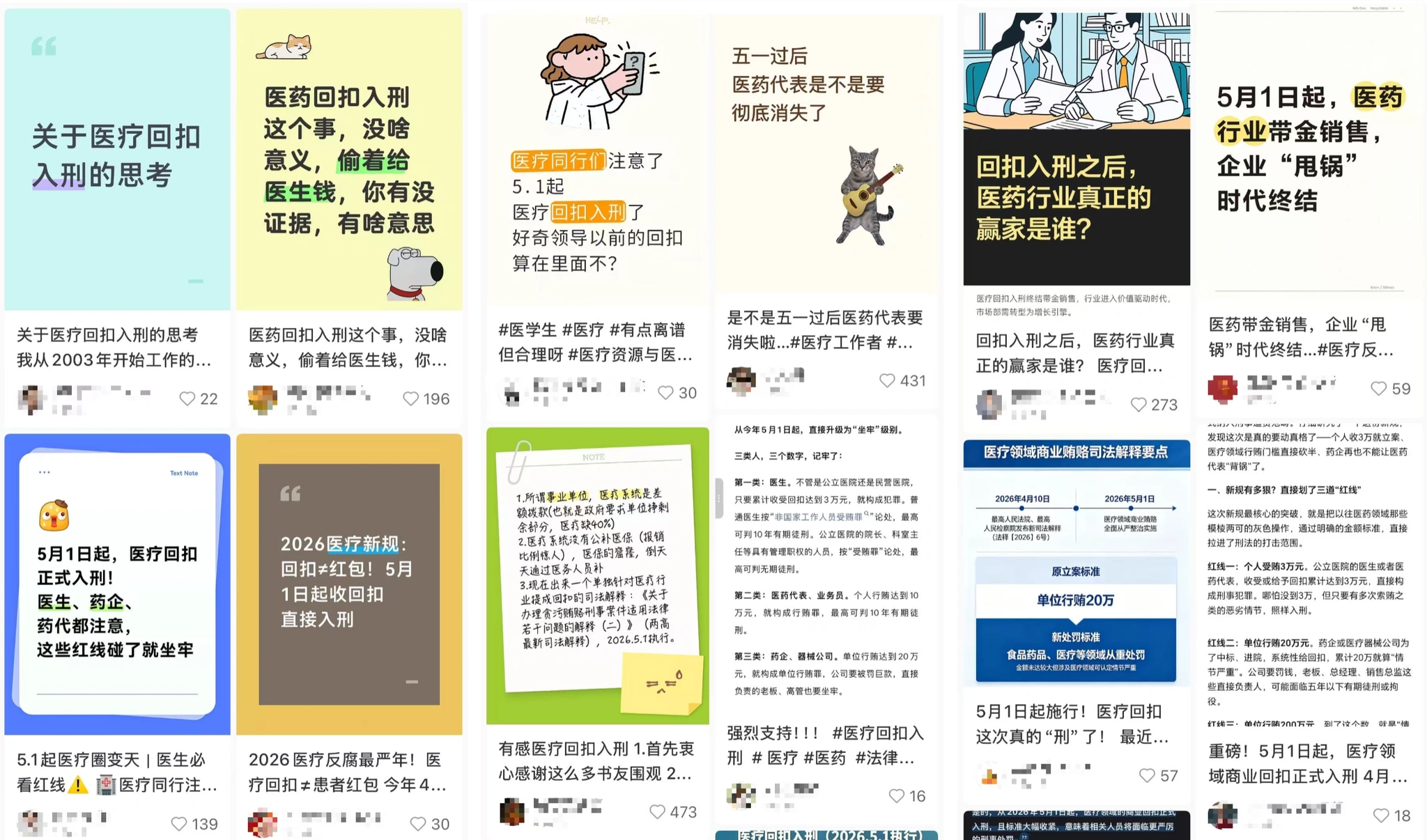 |
| Image source: A social media platform |
However, this statement is actually a misinterpretation.
"According to the Criminal Law and previous relevant judicial interpretations, commercial bribery in the medical field has always been suspected of constituting a crime," said Mr. Liu Xin, Director of the Center for Pharmaceutical Law and Ethics at China University of Political Science and Law. He clarified that Interpretation II does not create a new crime but incorporates new forms of bribery and acceptance of bribes that have emerged in the medical field in recent years into the scope of punishment, and clarifies the thresholds for incrimination and sentencing standards.
What truly deserves attention are three things happening simultaneously: a significant lowering of the threshold, a tightening of liability determination, and the medical field being singled out for heavier punishment. It is the combination of these three factors that constitutes the substantive power of this new red line.
The "Open Secret" of the Dental Industry
In the dental industry, commission-based sales have never been a secret.
Along the supply chain of Dental Implants, Digital Equipment, and Dental Consumables, various fees under names such as "academic visit fees," "lecture sponsorship," and "department activity support" have long played the role of lubricants maintaining procurement relationships. According to a report by "Southern Weekend," a former pharmaceutical representative with 23 years of experience from a leading pharmaceutical company revealed that upon joining, they had to sign an agreement stipulating that the sales methods employed were "personal actions" and unrelated to the company.
This model of "personal separation" may face more direct legal risks after Interpretation II takes effect.
The reality in dentistry is: equipment procurement and Consumables catalog access in public hospital dental departments, as well as VBP negotiations for Private Dental Practice chains, may involve a significant amount of gray-area operations like "thank-you fees," "consultancy fees," and "academic support." Calculated cumulatively, these fees have the potential to exceed the new criminal red line.
The 30,000 Yuan Red Line: A Substantial Lowering of the Incrimination Threshold
Core Change One: Substantial Lowering of the Incrimination Threshold
According to "Interpretation I" from 2016, the starting point for the "relatively large amount" constituting the crime of accepting bribes by non-state functionaries was typically set at 60,000 yuan. In Interpretation II, the standards for conviction and sentencing for the crime of accepting bribes by non-state functionaries (which applies to most clinical doctors) are uniformly aligned with those for the crime of accepting bribes by state functionaries—meaning the starting point is now 30,000 yuan.
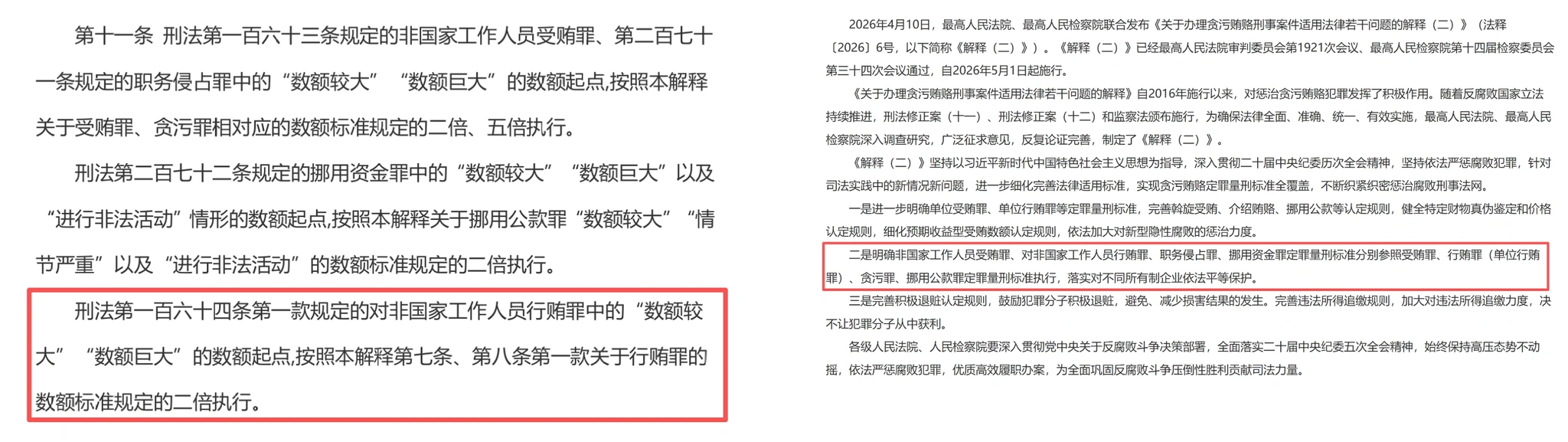 |
| Left: "Interpretation I" from 2016, Right: "Interpretation II" from 2026 |
This means: a general practitioner at a Private Dental Practice clinic could face criminal liability if they cumulatively receive "benefit fees" from a Consumables brand owner or distributor amounting to 30,000 yuan. The same applies to dentists in public hospital dental departments.
Key Detail: The 30,000 yuan is a cumulative amount with no time limit. Professor Wang Yue from the School of Medical Humanities at Peking University reminds us, "The new regulation should not be applied retroactively; a line should be drawn from now on." However, starting May 1, every kickback received thereafter will be included in the cumulative calculation.
Core Change Two: Significant Increase in Sentencing Ceilings
Ordinary medical personnel (non-state functionaries) will be dealt with under the crime of accepting bribes by non-state functionaries, with a maximum sentence of 10 years imprisonment. Meanwhile, personnel with management authority in public hospitals, such as hospital directors, will be prosecuted for the crime of accepting bribes, with a maximum sentence of life imprisonment.
Mr. Liu Xin pointed out, "The impact will be relatively significant for hospital management." Collective rebates often flow into some hospitals' "small accounts." In the past, punishment was limited due to "the law not punishing the multitude," but this may change significantly in the future.
Core Change Three: The Medical Field is Singled Out
Interpretation II explicitly mentions the "medical field" and connects with the provisions of the "Criminal Law Amendment (XII)" regarding circumstances warranting heavier punishment. Previous judicial interpretations only listed fields such as food, drugs, work safety, and environmental protection, without including the word "medical." This means that within the relevant monetary ranges, if circumstances such as "offering bribes in the medical field to carry out illegal or criminal activities" exist, the related acts may be pursued for criminal liability or deemed "serious circumstances."
Who Faces the Highest Risk?
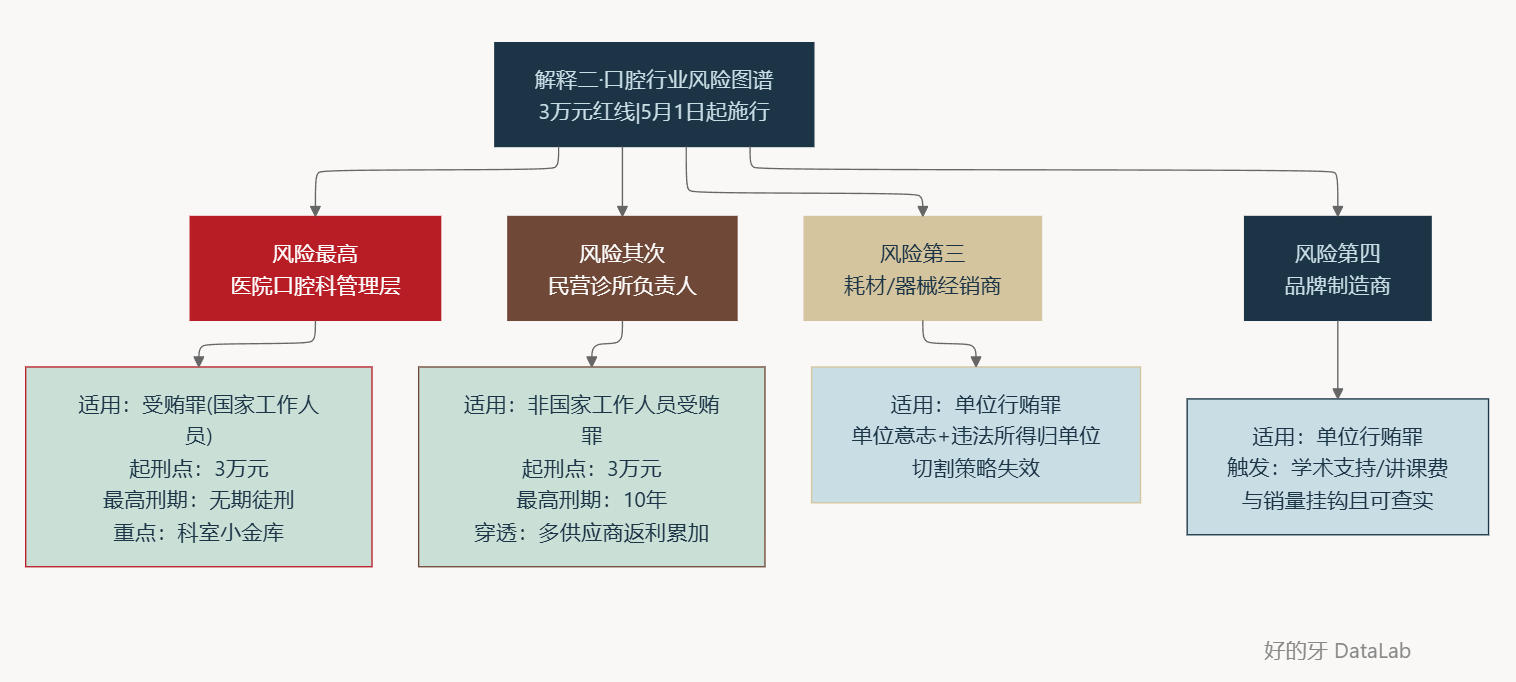
The impact of Interpretation II on different roles within the dental industry varies.
Highest Risk: Hospital Dental Department Management
Public hospital directors, heads of dental departments, procurement officers—personnel with administrative positions fall under the crime of accepting bribes by state functionaries. Not only is the incrimination threshold the lowest (30,000 yuan), but the sentencing ceiling is also the highest (life imprisonment). Collectively decided and distributed "departmental slush funds" may become key targets for crackdowns.
Second Highest Risk: Private Dental Practice Owners (Individuals Accepting Kickbacks)
Private Dental Practice owners typically do not hold "state functionary" status and will be handled under the crime of accepting bribes by non-state functionaries. The incrimination threshold is also lowered to 30,000 yuan, with a maximum of 10 years imprisonment. For many Private Dental Practice owners with high annual sales volumes, once "rebates" or "consultancy fees" from multiple Consumables suppliers are identified through investigation, the likelihood of exceeding 30,000 yuan is quite high.
Third Highest Risk: Dental Consumables/Equipment Distributors
Distributors are both the primary implementers of bribery and the party most easily "separated" by pharmaceutical companies. The unit bribery clause in Interpretation II will break this separation. Lu Yijie, a partner at Beijing Zhongwen Law Firm, stated, "As long as the bribery act is based on the unit's will and the illegal gains belong to the unit, it will be treated as the crime of unit bribery, rendering the liability separation strategy between pharmaceutical companies and distributors completely ineffective."
Fourth Highest Risk: Brand Manufacturers
Brand owners (e.g., import Dental Implant agents, domestic equipment manufacturers) who have sales policies linked to market promotion funds tied to "academic support" or "lecture fees," and where a direct link to Consumables/equipment sales volume can be verified, will face "unit bribery" liability.
 |
Companies Can No Longer "Separate" Liability
Article 16 of Interpretation II stipulates: For offering bribes to state functionaries to seek improper benefits, if the circumstances involve "collective decision by the unit, with illegal gains belonging to the unit" or "decision by the actual controller or responsible person of the unit, with illegal gains belonging to the unit," it shall be convicted and punished as the crime of unit bribery.
This provision directly blocks loopholes in the determination of unit crimes within the dental industry.
The standard practice for many dental Consumables companies has been: have distributors sign agreements stating that "sales actions are personal actions," so that in case of trouble, they can separate from the distributor, leaving the distributor to bear the consequences alone. However, the piercing recognition in Interpretation II breaks this logic: as long as the benefits belong to the enterprise, liability cannot be separated.
Zhang Yanfeng, a senior partner at Beijing Jingdu Law Firm, pointed out that the old judicial interpretation did not address the monetary standards for non-state functionary duty-related crimes, leading to inconsistent judicial standards across regions. In some areas, amounts below 1 million yuan for the crime of duty encroachment were considered "relatively large," resulting in widespread "different judgments for the same case." Interpretation II unifies the standards, meaning that operations previously relying on vague standards to "exploit loopholes" will largely become ineffective.
Forcing Industry Restructuring: Challenges and Opportunities Coexist
"The new judicial interpretation is very meaningful for severing the economic interest relationships between pharmaceutical representatives and doctors/hospitals," said Mr. Wang Yue. He noted that while past laws regulated medical commercial bribery, this interpretation is clearer and more targeted.
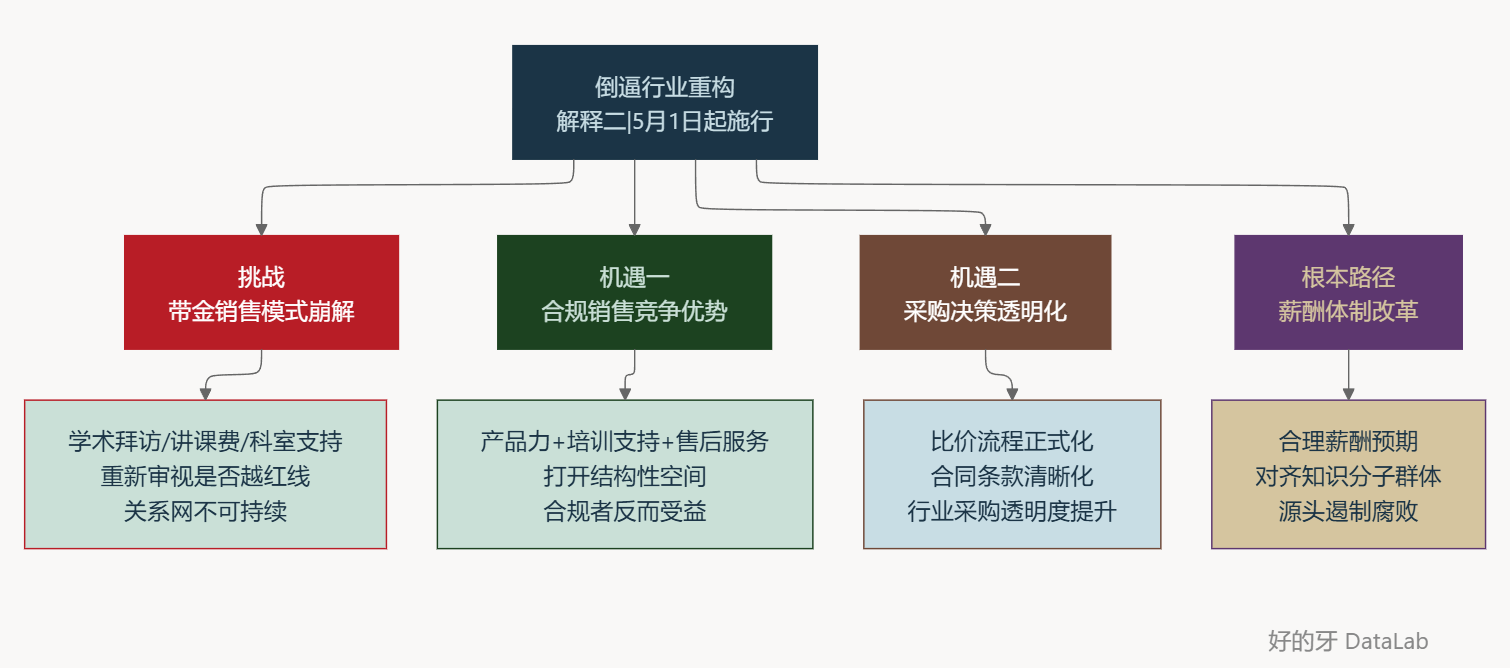
Returning to the daily operations of the dental industry, after this red line is implemented, changes will not only occur in terms of "catching or not catching" but will propagate down the procurement, sales, and internal governance chains. Several things are more likely to happen simultaneously:
The customer relationship networks previously maintained by "rebates" and "lecture fees" will quickly lose their elasticity in the face of criminal risks. Whether it's academic visits by import Dental Implant brands or departmental support for domestic equipment, each must be reviewed scenario by scenario: which parts constitute compliant academic and service activities, and which have crossed the legal red line.
Following this is a reordering of competition methods. Brand owners who have already established compliant sales systems, relying more on product strength, training support, and after-sales service to win clinic procurement, will gain a structural advantage in the new landscape—when competitors' "relationship"-based sales paths are blocked, space opens up for compliant operators.
As risk awareness increases, clinic owners in procurement decisions will often lean more towards traceable processes: more formal price comparisons, clearer contract terms, and more justifiable selection reasons. For the industry, this will push more transactions back from "tacit understanding" to "rules," enhancing procurement transparency.
However, relying solely on criminal deterrence will not automatically eliminate the soil for gray-area benefits. Medical professionals generally believe it is still necessary to return to the fundamental aspect of salary system reform. Mr. Wang Yue proposed: "Medical personnel must have reasonable salary expectations, which should be compared with similar intellectual professional groups in China and with national public servants in their locality." Otherwise, without correcting the income inversion, relying solely on criminalization for strong regulation may still result in diminished reform effectiveness.
 |
Afterword
The introduction of Interpretation II essentially marks China's medical anti-corruption efforts entering a phase of "precision strikes." From the administrative investigations of the medical anti-corruption storm around 2015, to the legislative upgrade of the "Criminal Law Amendment (XII)" in 2024, and now to the judicial precision of Interpretation II in 2026, this governance trajectory is clearly visible.
For the dental industry, "drawing a line from now on" is not just a legal statement but a watershed for business models. Brand owners and distributors still relying on gray-area benefits to maintain customer relationships will no longer face administrative fines but criminal liability.
30,000 yuan, cumulative, not retroactive, starting May 1.
This line has been drawn.
| About DGN:DentalGoodNews (DGN) is a trusted professional media platform dedicated to the global dental industry. We deliver in-depth coverage of corporate news, policy & regulation, investment & funding, and clinical frontiers — serving dental institutions, device manufacturers, investors, and industry researchers worldwide. Contact us: haodeya@dongxizixun.com |

;)