Aiming to reduce reliance on overseas manufacturing, Himed partners with Adva Cera to build a U.S.-based vertical supply chain for 3D Printed Dental Implants.
 |
| Source: Himed Official Website |
DentalGoodNews|On May 27, 2026, bioceramic material supplier Himed and ceramic Additive Manufacturing service provider Adva Cera announced a strategic partnership. The two parties will jointly create a complete path from development and validation to large-scale production of 3D-printed calcium phosphate (CaP) components for dental, orthopedic, and spinal applications, aiming to address the bottleneck in transitioning Medical Devices from prototype validation to large-scale manufacturing. Additionally, both parties stated that this collaboration offers a vertically integrated U.S. domestic supply chain route, helping relevant manufacturers reduce reliance on overseas Additive Manufacturing (AM) / 3D Printing chains.
According to public information, Himed is a bioceramic supplier with 35 years of material R&D experience, focusing on the medical implant market. In 2024, the company launched the "Bioceramics Center of Excellence™" (BCoE), providing bioceramic design and development support for medical device startups and established manufacturers, helping clients optimize 3D-printed bioceramic solutions before entering large-scale production. The partner, Adva Cera, is a ceramic Additive Manufacturing service provider equipped with industrial-grade 3D printing platforms and production environments. The company specializes in large-scale manufacturing of high-performance ceramic components, and its near-net-shape technology shortens the processing flow from printing to finished product while reducing material waste.
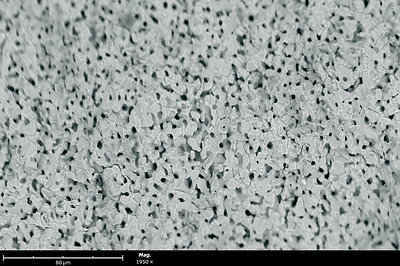 |
| Scanning electron microscope (SEM) image showing a lithography-based 3D-printed surface, primarily composed of beta-tricalcium phosphate (β-TCP); β-TCP is one of many bioresorbable bioceramic printing materials currently under development by Himed (Old Bethpage, New York). |
According to disclosures from Himed and Adva Cera, the core value of this partnership lies in establishing a seamless production path: Previously, after completing prototype validation, medical device companies often faced challenges such as switching suppliers, re-qualifying materials, and high infrastructure investment costs. Through this collaboration, clients can directly transfer their designs to the latter's large-scale production line after optimization at BCoE. According to the disclosure, this move enables clients to achieve a smooth transition from prototype to mass production without requiring significant new investments in printing infrastructure.
It is reported that all-bioceramic implants, due to the similarity of calcium phosphate to human bone mineral composition, can directly bond with surrounding tissues, offering biological advantages in dental and orthopedic fields. As ceramic Additive Manufacturing technology matures, industry research institution AM Research predicts that by 2033, the ceramic 3D printing market size will approach $900 million. According to disclosures, this partnership aims to bridge the practical gap between R&D design and compliance, as well as large-scale production.
| About DGN:DentalGoodNews (DGN) is a trusted professional media platform dedicated to the global dental industry. We deliver in-depth coverage of corporate news, policy & regulation, investment & funding, and clinical frontiers — serving dental institutions, device manufacturers, investors, and industry researchers worldwide. Contact us: haodeya@dongxizixun.com |

;)