DGN Insights × Dami: 69.2% of People Earn Less the Busier They Get, Where Has the Money in the Dental Market Gone?
 |
# Editor's Note
69.2% of dental practitioners feel busier, yet their income hasn't increased—this isn't a matter of individual laziness or diligence, but more like a signal that an old path is becoming obsolete. In the same year, the market still saw a net increase of nearly ten thousand clinics. The money hasn't disappeared; it has simply changed course: withdrawing from the familiar growth narrative and flowing to places that are more discerning and structurally sound.
Mai Zijian, Co-founder of DENTALGOODNEWS (Leading Dental Industry Media, DGN) and Partner of JiZhou Online. The combined user base of DGN and JiZhou Online serves over 1 million dental practitioners. Since 2023, the team has been continuously tracking clinic opening data in lower-tier markets, attempting to piece together seemingly scattered opening and closing activities into verifiable trends.
On April 10, 2026, at the Envista Service Partner Annual Meeting, he didn't present "trends" as the answer. Instead, he focused the question on three more verifiable clues: which of the four types of clients are still making money; how compliance demands translate into service premiums after the "114 Policy"; and how AI enables one salesperson to cover more clinics. The following is the full text compiled by the editorial team based on the on-site recording.
 |
## The Number That Makes You "Restless"
Let me start with the most stinging number: in 2025, our multi-platform joint survey showed that 69.2% of practitioners are busier, but their income hasn't increased. Nearly half of the labor input hasn't translated into concrete economic returns—it's not a lack of effort, but effort applied in the wrong direction.
 |
The old logic was straightforward: attend more courses, visit more clients, and business would grow. That doesn't seem to work anymore. There's even a situation where the busier you are, the greater the pressure, yet income remains stagnant.
## Where Did the Market's Money Go?—Four Types of Clients with Completely Different Needs
The differentiation within the dental industry is happening faster than most people realize. I've simply categorized the private market into four types of clients:
1. Price-Cutting Type. Attracts patients by lowering prices, but volume doesn't increase—squeezed from both ends, profits get thinner and thinner. This type carries a higher risk coefficient. 2. Regional Volume-Driven Type. Operates a few clinics in a specific region, with low average ticket price and high customer acquisition cost, sustained by volume. Efficiency is paramount. 3. Brand-Owned Chain. Financially healthy, supported by brand strength, demands more from suppliers—seeking professional services related to the supply chain, not just products. 4. Small-Town Boutique Clinics. Centered around private practice dentists, charges are not low, patient loyalty is high, and growth has been very rapid in recent years. This client group is generally overlooked, but it is precisely the group that restorative systems and comprehensive solutions should focus on.
The needs of these four client types are completely different. A simple logic: if your client isn't making money, you can't extract profit from them. So the question is direct—which of your current clients are making money?
## Incremental Growth Might Not Be Where You Think
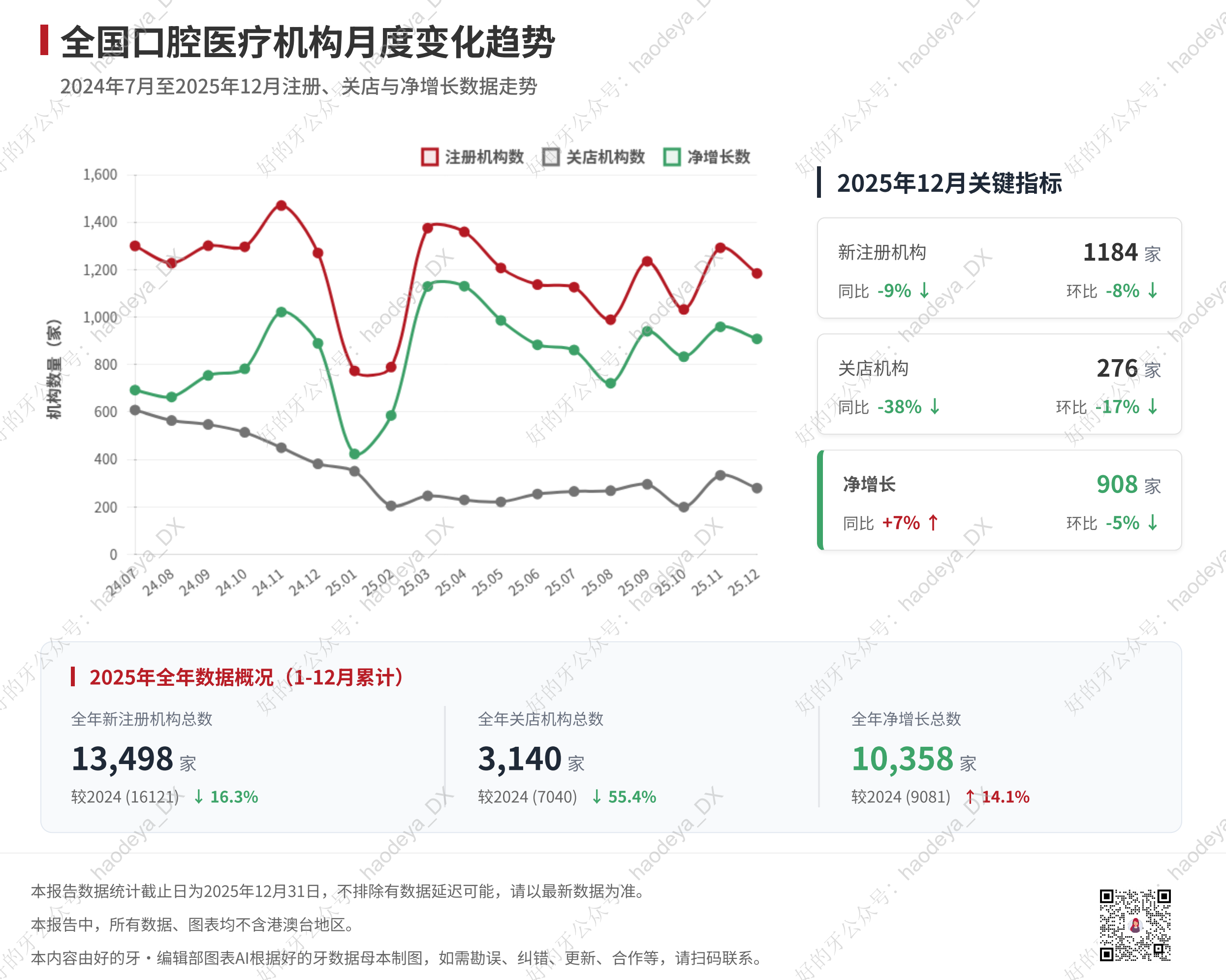
DGN DataLab statistics as of December 2025 show: 13,000 new dental medical service registrations for the full year, a 16% decrease from 2024; over 3,000 total clinic closures for the full year, a 5% decrease from 2024.
What's truly counterintuitive is the net growth: a net increase of approximately 10,000 clinics for the year. The restaurant industry basically sees one opening for every closure—that's a saturated market. The dental industry still nets an increase of 10,000 clinics a year—demand is still there, it's just that the incremental growth isn't where you might think.
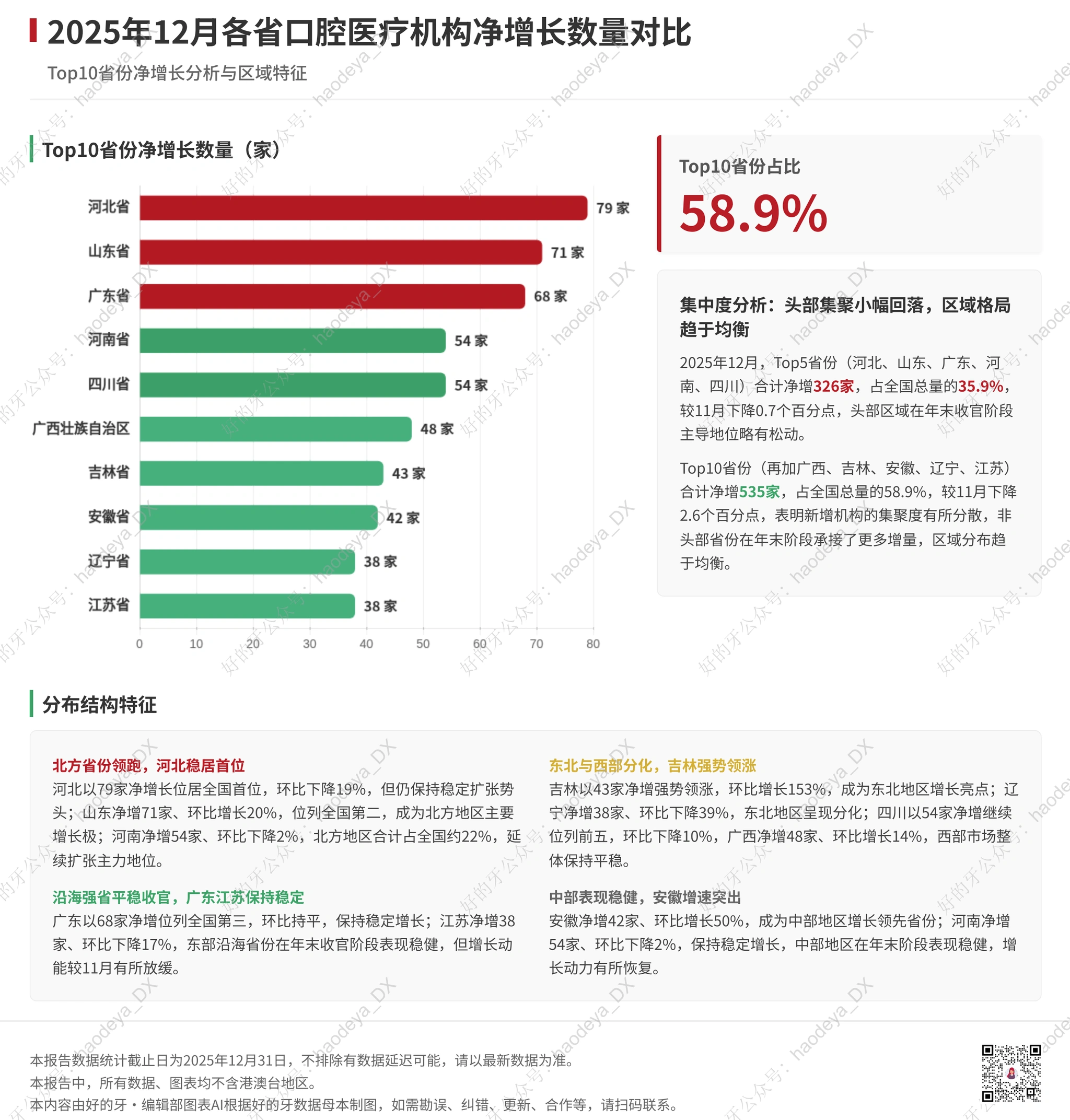
Where is it growing? The regions with the most growth are not Beijing, Shanghai, Guangzhou, or Shenzhen, but Hebei, Shandong, and then Guangdong.
More crucially, it's the lower-tier markets. We noticed this signal back in 2023. I specifically revisited the annual review data from December 31, 2023, and found Chongqing's situation very interesting even then: excluding new openings in the nine main urban districts, the lower-tier regions alone opened 363 new clinics—we spotted this trend in 2023. The growth rate of new clinic openings in lower-tier markets has already surpassed that of main urban districts.
 |
Editor's Note: When XAG initially made agricultural drones, their users were young pilots, and the products pursued being "cool and flashy." But when XAG decided to pivot to real farmers, they made a counterintuitive decision: leave the screws exposed—because farmers would immediately know how to tighten them. This seemed like a "downgrade," but was actually precise user insight: farmers don't want aesthetically pleasing shapes; they want usability, durability, affordability, and the ability to repair things themselves. True penetration into lower-tier markets isn't about lowering your posture, but about making products that hit the sweet spot for users.
## The "114 Policy": Not Bad News, but a Screening Signal
 |
Speaking of this, we must mention the "114 Policy." The state consolidated dental medical service price items to 114—we started tracking and reporting on this from February 2025. After local releases, page views reached hundreds of thousands, and doctors' reactions were very direct.
Compliance and finance/taxation are interlinked. Situations vary across regions, with differences in prices and items. This is precisely the advantage for service providers—you are distributed across provinces, you know the specific implementation details in your province earlier than any headquarters. Whoever first figures out the solution for their province can first help clients meet their needs.
Compliant operation itself is a demand. Industry service providers have already started holding specialized finance and tax lectures, and associations are conducting related training. The key point: for a clinic to become compliant, it requires manpower, material resources, learning costs, and changing pricing—it has to go through this entire process. But as a service provider, once you develop one system, you can serve all clinics within your coverage area. Each province has its barriers; experience from Province A cannot be directly copied to Province B—this actually constitutes your professional barrier.
When I accepted this invitation, I kept thinking about one question: what exactly are service providers doing? The answer I propose is eight words—providing replicable professional services. It's not about doing the doctors' jobs, but about understanding the doctors' needs and then providing them with that set of professional services that can be replicated within your service scope.
 |
## AI: Three Stages, Which One Are You In?
After this analysis, one final question remains: workload is increasing, costs are rising, income isn't—without new methods, this contradiction has no outlet.
Our research found that 60% of practitioners in the market have been exposed to AI, but only 10% are actually using it. For most people, their relationship with AI is "performance"—like opening Doubao (an AI assistant) and chatting with it, feeling like they've used AI.
Editor's Note: In 2025, a Swiss study involving 114 dental professionals found that only 21.9% of respondents used AI at least once a week, and the older the practitioner, the lower their belief in AI's practicality. The dental industry is in the chasm stage between "early adopters" and "early majority"—those still watching and waiting aren't being conservative; they are waiting for a comprehensive solution that includes training, compliance, and workflow integration. The bottleneck for technology adoption is never the technology itself, but the磨合期 (run-in period) between people and technology.
In my personal understanding, the relationship with AI can be divided into three stages:
1. Tool Layer. Treating AI as a tool for communication and inquiry—generating content, handling documents, analyzing data. Marketing and promotional content generation is currently the most applied scenario, followed by document processing and data analysis. Most people are already at this layer. 2. Partner Layer. The emergence of Agents (intelligent agents) turns AI into an independently operating entity. You can build an Agent specialized in legal analysis, one for financial organization, one for customer follow-up—each taking on specific responsibilities and operating continuously. 3. Management Layer. Multiple Agents collaborate, enabling one salesperson to simultaneously serve a large number of clients and clinics. Their professional knowledge deeply integrates with your product library and database—and what you need to learn is no longer just how to use AI, but how to manage AI.
## Your Clients' Purchasing Logic is Already Changing
Finally, let's talk about something many might not have realized yet. Your clients' way of obtaining information has changed. In the past, with poor information flow, they asked friends; later, they searched online—this was the backdrop for the rise of e-commerce; now, with the proliferation of AI, your clients will directly ask the AI in their phones: "How is this brand?" "Which product has a stable reputation?"
Your users have changed their behavior and their purchasing decision paths. Whether you can grasp this change will become part of your future competitiveness.
The rules have changed—but they've only changed. Demand is still there: the market nets an increase of about 10,000 clinics a year, the growth rate of new clinic openings in lower-tier markets continues to outpace main urban districts, and compliance demands are turning into concrete service purchases.
The content of this article has been reviewed and authorized for publication by the speaker. The views expressed are based on the speaker's personal practical experience and are for reference and exchange only. They do not constitute investment, operational, or decision-making advice for any institution or individual. Policies and market environments in the dental industry are continuously changing. Readers are advised to conduct prudent assessments based on their own actual circumstances.
你的客户,采购逻辑已经在变
最后说一件可能很多人还没意识到的事。你的客户,信息获取的方式已经变了。以前信息不流通,他们问朋友;后来上网查——这是电商崛起的背景;现在,随着AI的普及,你的客户会直接问手机里的AI:「这个品牌怎么样」「哪个产品口碑稳」.
你的用户改变了行为方式,改变了采购决策路径。能不能在这个变化上把握住,会成为你未来竞争力的一部分.
规则变了——但也只是变了。需求还在:市场一年净增约1万家,下沉市场的开店增速持续超过主城区,合规需求正在变成具体的服务采购.
 |
| About DGN:DentalGoodNews (DGN) is a trusted professional media platform dedicated to the global dental industry. We deliver in-depth coverage of corporate news, policy & regulation, investment & funding, and clinical frontiers — serving dental institutions, device manufacturers, investors, and industry researchers worldwide. Contact us: haodeya@dongxizixun.com |

;)