A team from Wuhan University has published a dental imaging model in <Nature> sub-journal, achieving clinical-grade analysis with support from 100,000-level data.
 |
| Source: "Towards clinical-level interpretation of dental panoramic radiography using an instance-guided vision-language model" |
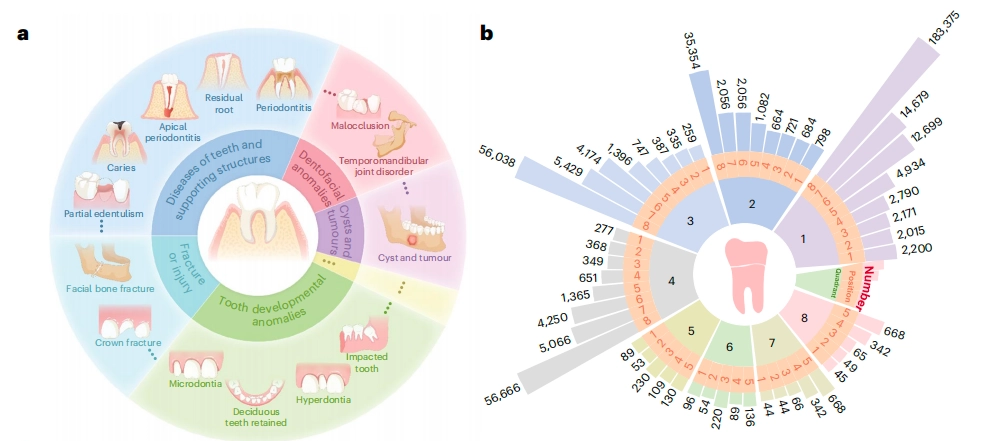
DentalGoodNews | On June 25, 2026, a large-scale oral imaging study involving over 101,000 patients, published in Nature Biomedical Engineering, showed that the instance-guided visual language model DentFound, developed by Professor Meng Liuyan's team at the Hospital of Stomatology, Wuhan University, demonstrated clinical-grade performance in the auxiliary diagnosis and report generation tasks of oral panoramic radiographs (Oral Panoramic Tomography/OPG). The quality of the diagnostic reports generated by the model was superior to or comparable to that of human radiologists.
According to the research team, panoramic radiographs are currently the most widely used radiographic tool in oral disease diagnosis. However, due to the relative scarcity of professional image interpretation resources globally, a large number of images often cannot be comprehensively interpreted in a timely manner, increasing the risk of missed or misdiagnosed cases. To address this pain point, the research team constructed a large-scale oral imaging dataset covering over 101,000 patients to support model training and validation.
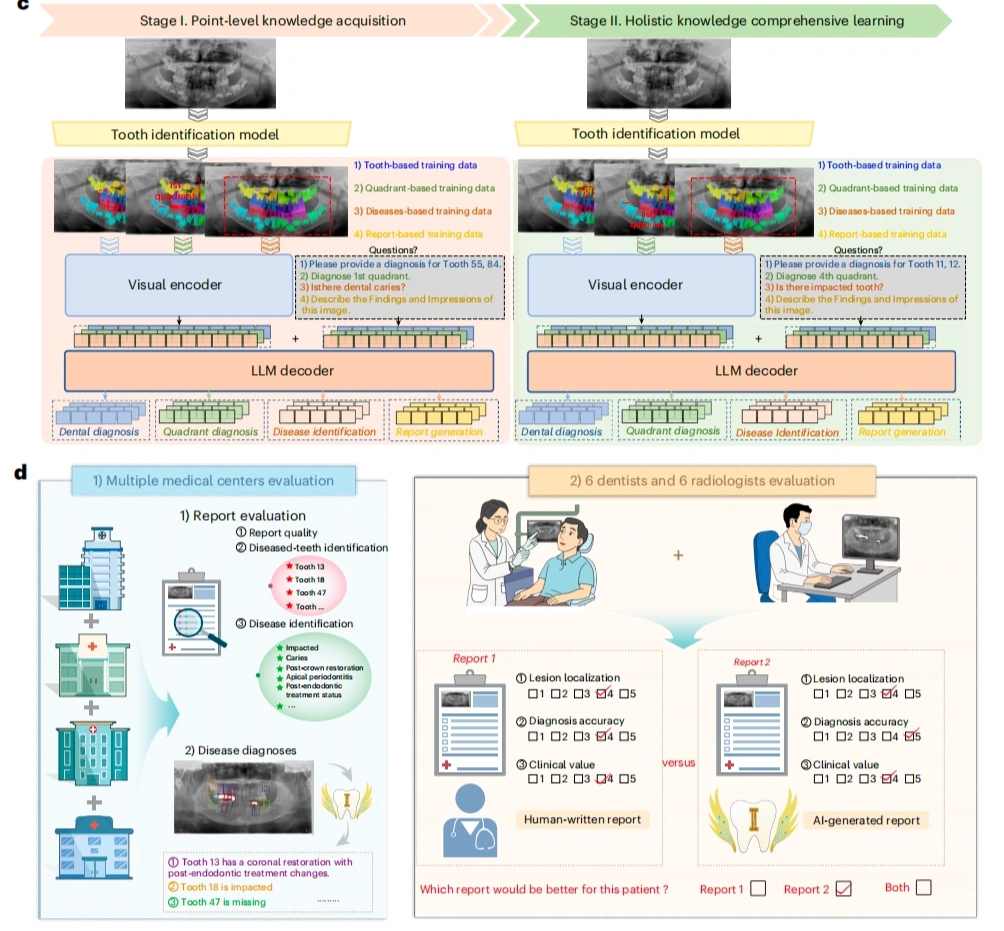
The research team stated that the core innovation of the DentFound model lies in integrating tooth instance information into visual representation learning. Through this mechanism, the AI can be guided to focus on specific tooth positions, lesion areas, and subtle post-treatment changes. Additionally, the team adopted multi-level knowledge resampling and progressive learning strategies, enhancing the model's fine-grained understanding of complex oral anatomical structures, thereby achieving an integrated analysis of lesion localization, disease diagnosis, and structured report generation.
 |
| Source: "Towards clinical-level interpretation of dental panoramic radiography using an instance-guided vision-language model" |
In the evaluation results, DentFound significantly outperformed existing medical visual language models in automated report generation and disease diagnosis. Expert assessments indicated that the quality of reports generated by the model was superior to or comparable to imaging reports written by radiologists. Bian Zhuan, Director of the Wuhan Branch of the State Key Laboratory of Oral & Maxillofacial Reconstruction and Regeneration, pointed out that this achievement marks a new path for oral AI from single-task recognition to clinical-grade comprehensive interpretation.
Currently, relying on the Hospital of Stomatology, Wuhan University, and related platforms, Professor Meng Liuyan's team has initially established a digital and intelligent technology-assisted platform for oral disease diagnosis and treatment, aiming to enhance the efficiency of medical services through intelligent imaging diagnostic systems, particularly to strengthen oral diagnosis and treatment capabilities in remote areas. This research was jointly funded by the National Natural Science Foundation of China, the Key Research and Development Program of Hubei Province, and the R&D Project of the Hospital of Stomatology, Wuhan University.
| About DGN:DentalGoodNews (DGN) is a trusted professional media platform dedicated to the global dental industry. We deliver in-depth coverage of corporate news, policy & regulation, investment & funding, and clinical frontiers — serving dental institutions, device manufacturers, investors, and industry researchers worldwide. Contact us: haodeya@dongxizixun.com |

;)