More than 39,000 Australians applied to withdraw retirement savings early to pay for dental treatment, up 5.9% year-on-year.
 |
| Source: Australian Taxation Office |
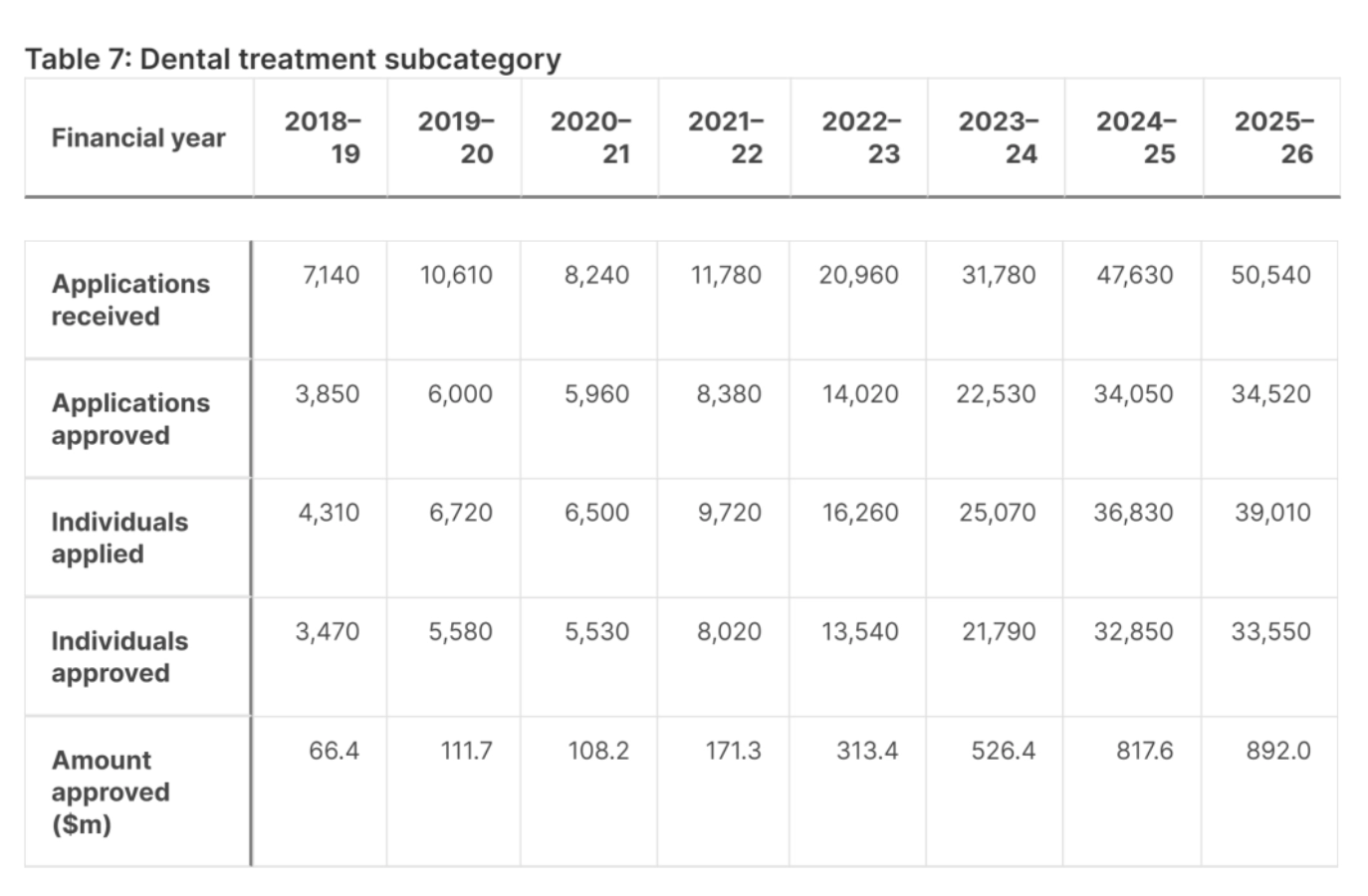
DentalGoodNews|On October 22, the Australian Taxation Office (ATO) updated its data on compassionate release of superannuation* for the 2025–26 financial year. The data shows that the amount approved for dental treatment was AUD 892 million (approximately RMB 4.198 billion), up from AUD 818 million (approximately RMB 3.848 billion) in the 2024–25 financial year, an increase of about 9.1%.
In the 2025–26 financial year, a total of 39,010 people submitted applications for compassionate release of superannuation for dental treatment, an increase of 2,180 from 36,830 in the 2024–25 financial year, representing year-on-year growth of 5.9%; the number of approved applicants was 33,550, an increase of 700 from 32,850 the previous year, representing year-on-year growth of 2.1%. The above figures are counted by individual, while the ATO allows the same person to apply multiple times within a single financial year: during the same period, there were 50,540 dental-related applications in total, up 6.1% from 47,630 the previous year. According to the Australian Dental Association, the growth rate in the number of dental-related applicants has slowed somewhat, but the approved amount continues to rise.
 |
| Source: Australian Taxation Office |
From an overall perspective, the ATO stated that in the 2025–26 financial year, the number of approved applications across all categories of compassionate release fell by 5%, but the total amount of superannuation approved increased by 2%, exceeding AUD 1.4 billion. The ATO emphasized that compassionate release applies only to strict and limited circumstances and should be considered only after all other payment options have been exhausted.
Since July 1, 2025, the ATO has conducted more than 160 reviews and audits targeting individuals, health practitioners and third-party intermediaries, focusing on cases where it believes there are false or misleading statements in applications or medical reports, and has imposed more than AUD 1.5 million in penalties. This amount is aggregate data across all relevant categories and is not broken out separately for dental.
The ATO stated that it will continue to crack down on health practitioners and third-party intermediaries, including dentists, who encourage individuals to improperly access their superannuation to pay for cosmetic dental procedures. ATO Deputy Commissioner Ben Kelly said that some commercial arrangements target and pressure individuals to access their superannuation, including through brief online consultations and templates designed to streamline the application process.
Justin Untersteiner, Chief Executive Officer of the Australian Health Practitioner Regulation Agency (Ahpra), said the regulator is concerned that some sales tactics use social media and internet advertising to attract patients into high-priced treatments they do not need or cannot afford.
The ATO noted that early withdrawal of superannuation may have tax implications: the approved withdrawal amount may be taxable and counted as assessable income for the individual, which may in turn affect eligibility for government benefits such as the Family Tax Benefit.
Chris Sanzaro, President of the Australian Dental Association, described the more than 39,000 people applying to access their superannuation to pay for dental treatment as "a sobering number." He said the superannuation safety net is important, but "it is not a dental system." The association stated that Australians typically face high out-of-pocket costs for dental treatment, public dental services are limited, and waiting times can be long; the association has updated its compassionate release guidance for dentists and patients and has expressed concern about promotions that use superannuation to pay for purely cosmetic dental procedures.
In addition, the Super Members Council (SMC) has called for a ban on advertising that promotes early withdrawal of superannuation for non-essential medical and dental procedures, and a ban on third parties charging fees solely for helping consumers fill out compassionate release applications. The SMC said its analysis shows that if a 30-year-old withdraws AUD 20,000 early for non-essential dental or medical procedures, they could have about AUD 93,000 less at retirement due to lost compound returns.
| About DGN:DentalGoodNews (DGN) is a trusted professional media platform dedicated to the global dental industry. We deliver in-depth coverage of corporate news, policy & regulation, investment & funding, and clinical frontiers — serving dental institutions, device manufacturers, investors, and industry researchers worldwide. Contact us: haodeya@dongxizixun.com |

;)