New Study: Toddlers’ Screen Time Increases to Over 1 Hour Daily, Dental Caries Odds Ratio 27% Higher
 |
| Source: Screen time trajectories from 18 months to 3 years and dental caries at age 3 years: a population-based cohort study in Japan |
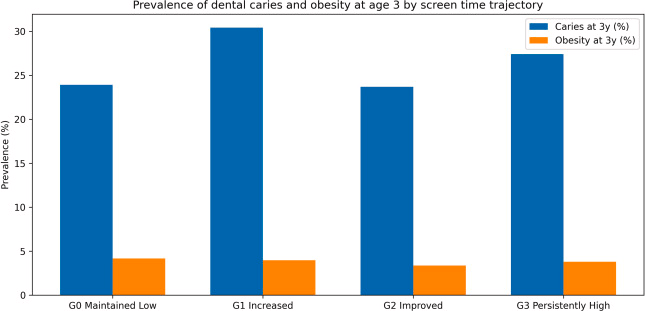
DentalGoodNews|On October 7, 2026, Pediatrics and Neonatology published a retrospective cohort study in a Japanese population. Using children's routine health checkup records from Okinawa Prefecture, Japan, from 2014 to 2019, the main analysis included 71,438 children and found that children with no regular screen use at 18 months whose average daily screen time increased to more than 1 hour by age 3 had an adjusted odds ratio (aOR) of 1.27 (95% CI 1.12–1.45) for dental caries at age 3, higher than that of children with persistently low screen exposure (no regular screen use at 18 months and no more than 1 hour per day at age 3).
The study divided children into four groups according to whether they had regular screen use at 18 months and whether their average daily screen time at age 3 exceeded 1 hour (the World Health Organization's recommended upper limit for children aged 2–4): persistently low, 4,597; increased to more than 1 hour, 1,919 (2.7%); improved group, 28,553; persistently high, 36,369 (50.9%). At the age-3 health checkup, caregivers reported screen time, and dentists assessed dental caries, defined as at least 1 decayed tooth. The model adjusted for factors including sex, single-parent family, childcare, routine juice consumption, skipping breakfast, and insufficient sleep, and also adjusted for the baseline prevalence of dental caries at 18 months.
The results showed that the "increased to more than 1 hour" group had the highest risk across multiple oral outcomes, including severe dental caries and number of decayed teeth: the aOR for severe dental caries (≥3 decayed teeth) was 1.55 (95% CI 1.31–1.84), and the incidence rate ratio (IRR) for the number of decayed teeth was 1.29 (95% CI 1.14–1.46). (aOR is an odds ratio and IRR is a rate ratio; the two should not be directly compared in magnitude.)
 |
| Source: Screen time trajectories from 18 months to 3 years and dental caries at age 3 years: a population-based cohort study in Japan |
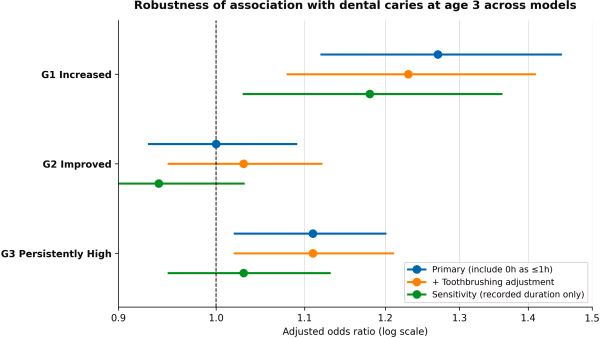
To test the robustness of the results, the researchers conducted sensitivity analyses: after excluding children with no screen use at all at age 3, the aOR for dental caries in the persistently high group decreased from 1.11 to 1.03 (95% CI 0.95–1.13) and was no longer statistically significant, suggesting that the association in this group was relatively sensitive to the composition of the reference group; the aOR in the increased group remained 1.18 (95% CI 1.03–1.36), and the association was relatively stable.
The increased group accounted for only 2.7% of the sample and had more unfavorable daily habits: the proportion with routine juice consumption was 28.8% (15.9% in the persistently low group), skipping breakfast was 5.5% (2.1%), and parental assistance with toothbrushing was 74.6% (81.8%). The model had already adjusted for factors such as juice and breakfast; after additionally adjusting for toothbrushing assistance, the aOR for the increased group was 1.23; however, these habits may also be intermediate pathways through which screen use affects dental caries, so the above data can only indicate that screen use co-occurs with poor diet and toothbrushing habits, and cannot yet distinguish their respective effects.
The researchers suggest introducing screening and repeated counseling based on screen use trajectories into early childhood health checkups, and guiding families to maintain screen-free time during meals and toothbrushing.
This study has limitations: although the sample size was large and relied on the routine health checkup system, with examinations performed by dentists according to standardized processes; screen time was reported by caregivers, only "yes/no" was recorded at 18 months, there were only two time points, and data on household income, parental education, fluoride exposure, and other factors were lacking, so residual confounding cannot be ruled out, and the results are associations rather than causation.
| About DGN:DentalGoodNews (DGN) is a trusted professional media platform dedicated to the global dental industry. We deliver in-depth coverage of corporate news, policy & regulation, investment & funding, and clinical frontiers — serving dental institutions, device manufacturers, investors, and industry researchers worldwide. Contact us: haodeya@dongxizixun.com |

;)