HKU Team Develops AI Framework for Dental Crown Design: Design Time Cut by Over 90%, Single Case Generated in Under 1 Minute
 |
| Source: DentalGEN: a large-scale controllable generative AI framework for automated dental crown restoration |
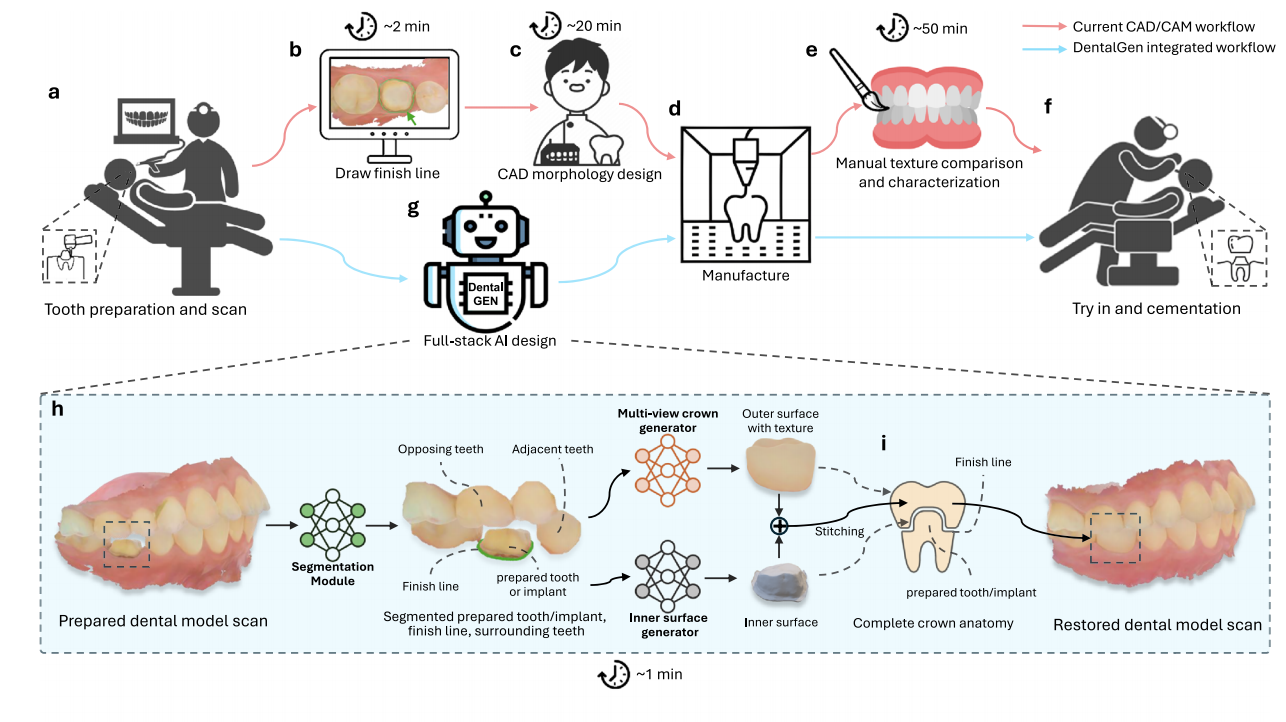
[SOURCE] DentalGoodNews|Recently, an international research team led by the Faculty of Dentistry at the University of Hong Kong published a study in npj Digital Medicine, introducing a controllable generative artificial intelligence framework called DentalGEN. This framework can automatically design personalized three-dimensional dental crowns that balance morphological, functional, and aesthetic requirements based on patient oral scan data. The study shows that compared with traditional manual design, this framework can reduce crown design time by more than 90%; in external testing, the Hausdorff distance (HD) of its design results was reduced by approximately 70% compared with existing advanced methods.
DentalGEN adopts a controllable multi-view diffusion model, using multiple clinical information items as constraints for crown generation. The system first extracts information from oral scan models, including the prepared tooth, adjacent teeth, opposing teeth, and preparation margin line, and combines color data from surrounding teeth to generate three-dimensional crown morphology and color texture that remain consistent across different views. Unlike existing methods that mainly focus on geometric morphology design, DentalGEN integrates crown morphology design and color texture generation into the same workflow.
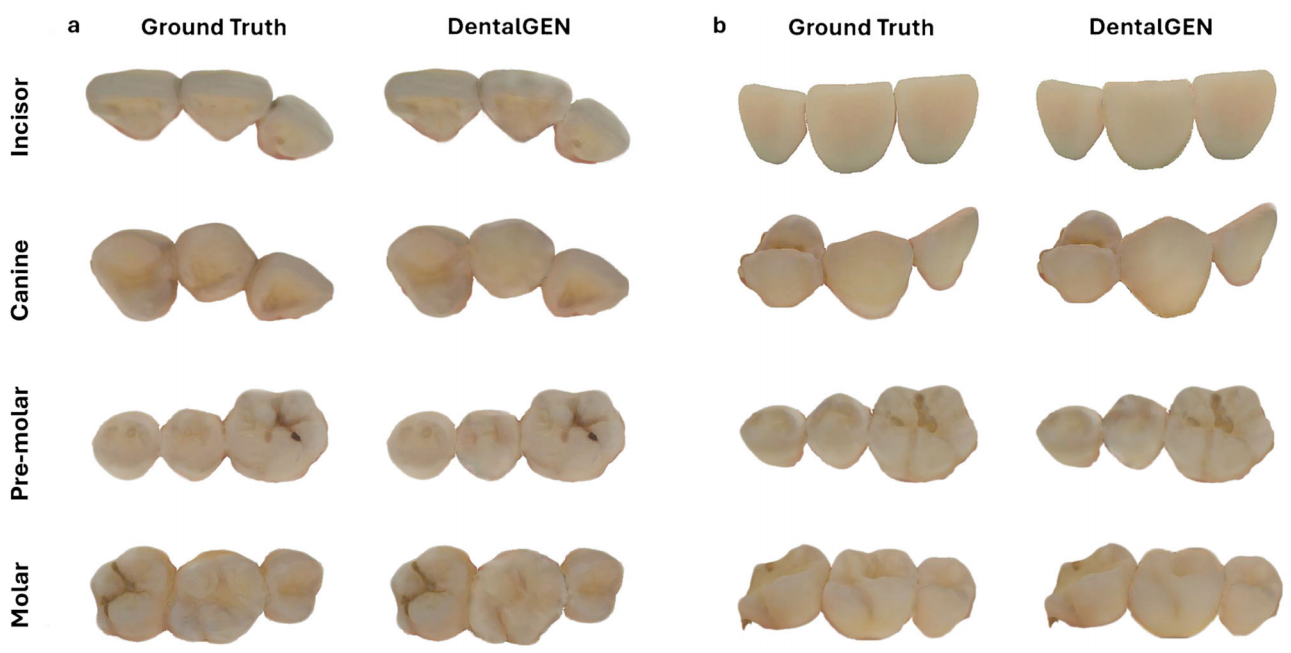
To evaluate the performance of this framework, the research team collected 26,614 crown samples from multiple hospitals and clinics, involving 7,880 patients. In external testing, the average Chamfer distance of crowns generated by DentalGEN was 0.447 mm, and the Hausdorff distance (HD) was 0.873 mm, approximately 47% and 70% lower than the control method DCPR-GAN, respectively. In addition, the research team selected 40 external cases, and 6 dentists conducted blinded scoring of AI-generated crowns and crowns designed by professional technicians according to modified FDI criteria. The results showed that there was no statistically significant difference in the average clinical scores between the two groups of crowns.
 |
| Source: DentalGEN: a large-scale controllable generative AI framework for automated dental crown restoration |
In terms of design efficiency, DentalGEN completed the entire process for a single crown on a device equipped with an NVIDIA RTX 3060 graphics card, from scan model segmentation and morphological reconstruction to manufacturing file export, in less than 1 minute. Compared with manual design by technicians, this framework can reduce the manual input time in the crown design stage by more than 90%.
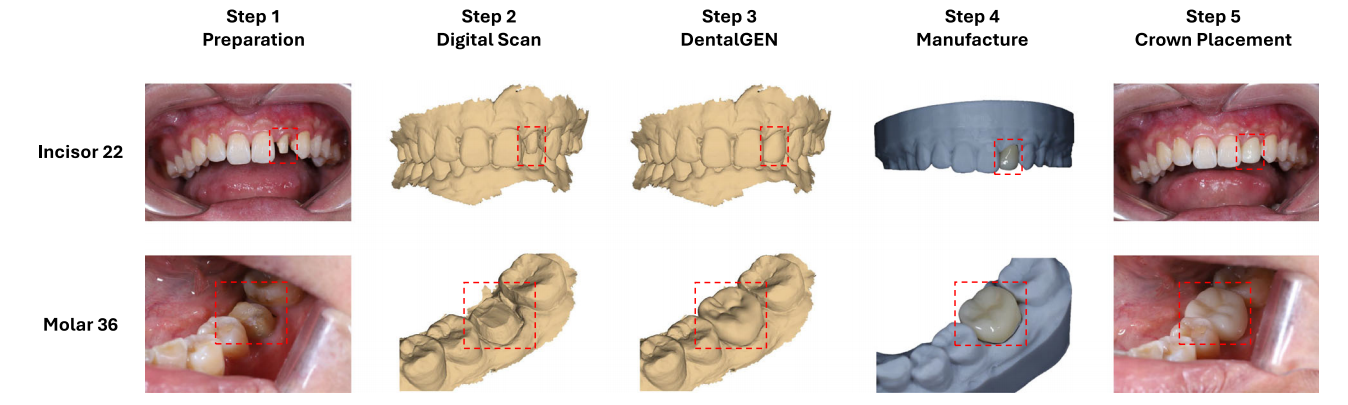
In addition to dataset evaluation, the research team also collaborated with Shanghai Ninth People's Hospital Affiliated to Shanghai Jiao Tong University School of Medicine to conduct clinical proof-of-concept validation on two real patients, involving the maxillary lateral incisor (22) and mandibular first molar (36). After the two patients completed tooth preparation and digital scanning, the researchers used DentalGEN to generate crown designs, then processed Zirconia / Zirconium dioxide crowns through a CAD/CAM system, and technicians performed staining and glazing with reference to the AI-generated color texture maps. Clinical try-in results showed that the occlusion, proximal contacts, and marginal fit of both restorations reached clinically acceptable levels.
 |
| Source: DentalGEN: a large-scale controllable generative AI framework for automated dental crown restoration |
At present, the color texture generated by DentalGEN is still mainly used to guide technicians in subsequent staining and glazing, and crown designs also need to be reviewed by dentists or technicians before entering the manufacturing stage. Therefore, at this stage, this technology mainly realizes crown design and its connection with the manufacturing workflow, and has not yet achieved unmanned operation of the entire restoration workflow. The research team has established a startup company to promote technology translation and plans to expand its application scope to complex restorations such as multi-unit dental bridges, Complete denture (CD), and titanium mesh.
It should be noted that this study is still in the clinical proof-of-concept stage, and real-patient application involved only two cases. The applicability of DentalGEN in different clinical environments, as well as the long-term clinical performance of restorations, still require further research and larger-scale clinical follow-up validation.
| About DGN:DentalGoodNews (DGN) is a trusted professional media platform dedicated to the global dental industry. We deliver in-depth coverage of corporate news, policy & regulation, investment & funding, and clinical frontiers — serving dental institutions, device manufacturers, investors, and industry researchers worldwide. Contact us: haodeya@dongxizixun.com |

;)