New study: AI-based 3D modeling of soft and hard tissues may improve the consistency of simulation planning for immediate implant placement in the anterior region.
 |
| Source: A novel AI-assisted three-dimensional hard- and soft-tissue hybrid model for peri-implant diagnosis and treatment planning: a proof-of-concept study on immediate implant planning in the anterior region |
DentalGoodNews|On October 2, 2026, the Journal of Dentistry published a proof-of-concept study online. The research team constructed an artificial intelligence (AI)-assisted patient-specific 3D hybrid soft and hard tissue model (PIM) and compared PIM-assisted planning with conventional Cone Beam Computed Tomography (CBCT) combined with Intraoral Scanning (IOS) planning in simulated planning for 30 cases of immediate implant placement in the maxillary anterior region. The results showed that, compared with conventional planning, the use of PIM resulted in smaller planning discrepancies among 3 experts in implant apical position and angle, while no statistically significant difference was observed in coronal discrepancies.
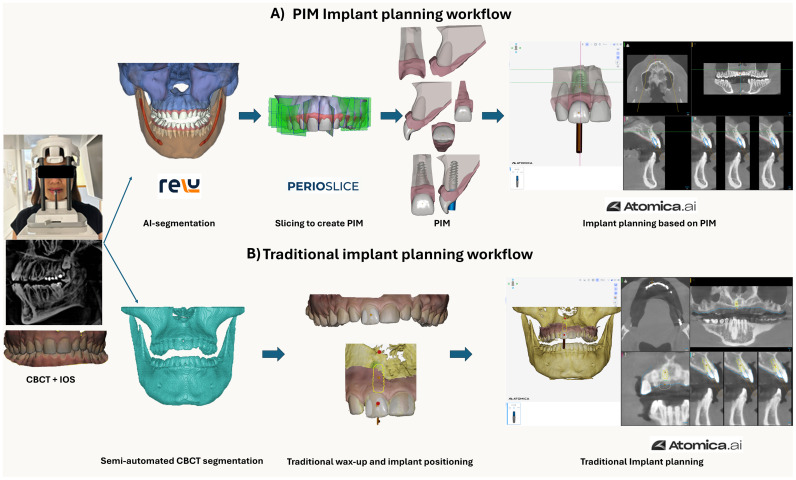
The research team noted that existing implant planning platforms can typically integrate Cone Beam Computed Tomography (CBCT) and IOS data, but usually do not systematically incorporate information such as gingival phenotype, gingival thickness, and local anatomy of the extraction socket. The study retrospectively included data from 30 patients from the periodontal clinic of University Hospitals Leuven (UZ Leuven) in Belgium, including 10 cases each of maxillary central incisors, lateral incisors, and canines. All patients had CBCT and IOS data and met the inclusion criteria relevant to immediate implant placement.
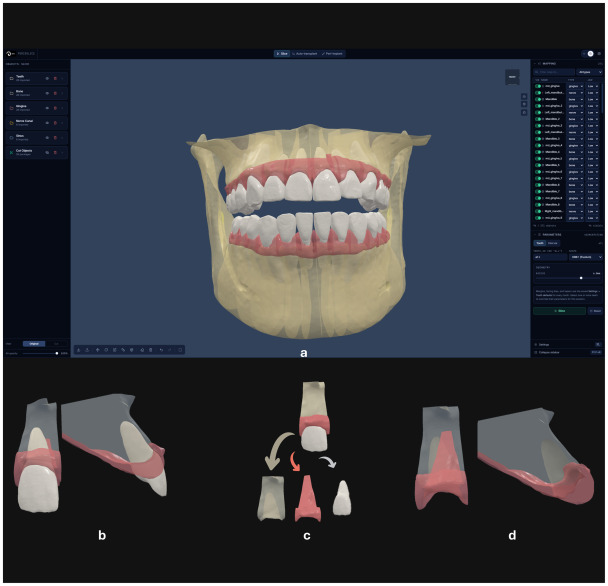
The researchers uploaded the CBCT and IOS data to the AI-driven cloud platform Relu Cloud to segment anatomical structures such as teeth, alveolar bone, and gingiva, and completed Registration and fusion of CBCT and IOS data through AI. Subsequently, the research team used PerioSlice software developed at KU Leuven to automatically generate patient-specific single-tooth models containing the target tooth, gingiva, and surrounding alveolar bone from the full-arch model.
 |
| Source: A novel AI-assisted three-dimensional hard- and soft-tissue hybrid model for peri-implant diagnosis and treatment planning: a proof-of-concept study on immediate implant planning in the anterior region |
In the Atomica.ai planning environment, the researchers hid the teeth to be extracted, generated simulated extraction sockets, and performed implant planning according to Prosthetically Driven Implant Placement principles. One expert each from Oral Surgery, prosthodontics, and periodontics (all 3 experts held doctoral degrees and had at least 5 years of relevant specialty clinical experience) independently completed virtual implant planning for 30 cases under two conditions: conventional planning used CBCT and IOS data and determined the restoration and ideal emergence profile through a virtual Diagnostic wax-up; PIM planning directly combined CBCT and the PIM model in the same planning environment for implant positioning.
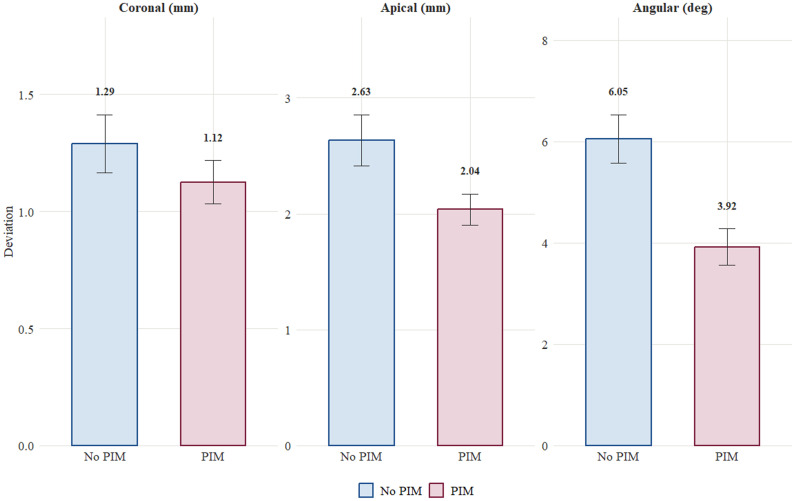
The study primarily evaluated pairwise implant planning discrepancies among the 3 experts, including 3 indicators: coronal, apical, and angular. The results showed that the mean inter-expert apical deviation decreased from 2.63 mm with conventional planning to 2.04 mm with PIM planning, with a model-estimated effect of −0.60 mm and Holm-adjusted p=0.009; the mean angular deviation decreased from 6.05° to 3.92°, with a model-estimated effect of −2.13° and Holm-adjusted p<0.001. Coronal deviation decreased from 1.29 mm to 1.12 mm, but the difference was not statistically significant (Holm-adjusted p=0.10).
 |
| Source: A novel AI-assisted three-dimensional hard- and soft-tissue hybrid model for peri-implant diagnosis and treatment planning: a proof-of-concept study on immediate implant planning in the anterior region |
According to the prespecified grading criteria of the study, the proportion of implants with angular deviation exceeding 7° decreased from 40.0% (12/30) with conventional planning to 6.7% (2/30) with PIM planning, and the difference was statistically significant (Holm-adjusted p=0.028). No statistically significant differences were observed in the proportions of major coronal and apical deviations; the proportions of major apical deviations were 63.3% and 50.0%, respectively, and those of major coronal deviations were 16.7% and 10.0%. The research team emphasized that these indicators reflect inter-expert planning consistency rather than the objective accuracy of implant position, and the study did not establish an independent "ideal implant position" as a reference standard, so it cannot be determined whether PIM planning is closer to an objectively correct position.
This study is a retrospective proof-of-concept study in a simulated environment; no actual implant placement was performed, and postoperative or long-term clinical outcomes were not evaluated. In addition, the study included only 3 experienced experts, the sample size was small, and the 3 experts came from Oral Surgery, prosthodontics, and periodontics, respectively, so specialty background could not be fully distinguished from individual expert effects. Conventional planning and PIM planning differed in segmentation method, model construction, virtual tooth extraction, and 3D visualization, and the improvement should be attributed to the overall PIM workflow rather than to gingival information alone.
| About DGN:DentalGoodNews (DGN) is a trusted professional media platform dedicated to the global dental industry. We deliver in-depth coverage of corporate news, policy & regulation, investment & funding, and clinical frontiers — serving dental institutions, device manufacturers, investors, and industry researchers worldwide. Contact us: haodeya@dongxizixun.com |

;)