New Data: U.S. Families Need to Work an Average of 14.2 Hours to Cover One Person’s Annual Dental Expenses
 |
| Source: "Dental Care Affordability Index" |
DentalGoodNews|Recently, Dental Reviewed released the "Dental Care Affordability Index," which, based on 2026 projected data, estimates that to cover one person's annual dental expenses, U.S. residents on average need 14.2 hours of household work time, with per capita dental spending at $619.
The index covers all 50 U.S. states, comparing each state's per capita annual dental spending with the local median household income. Dental spending data comes from the Centers for Medicare & Medicaid Services (CMS), and household income data comes from the U.S. Census Bureau.
 |
| Source: "Dental Care Affordability Index" |
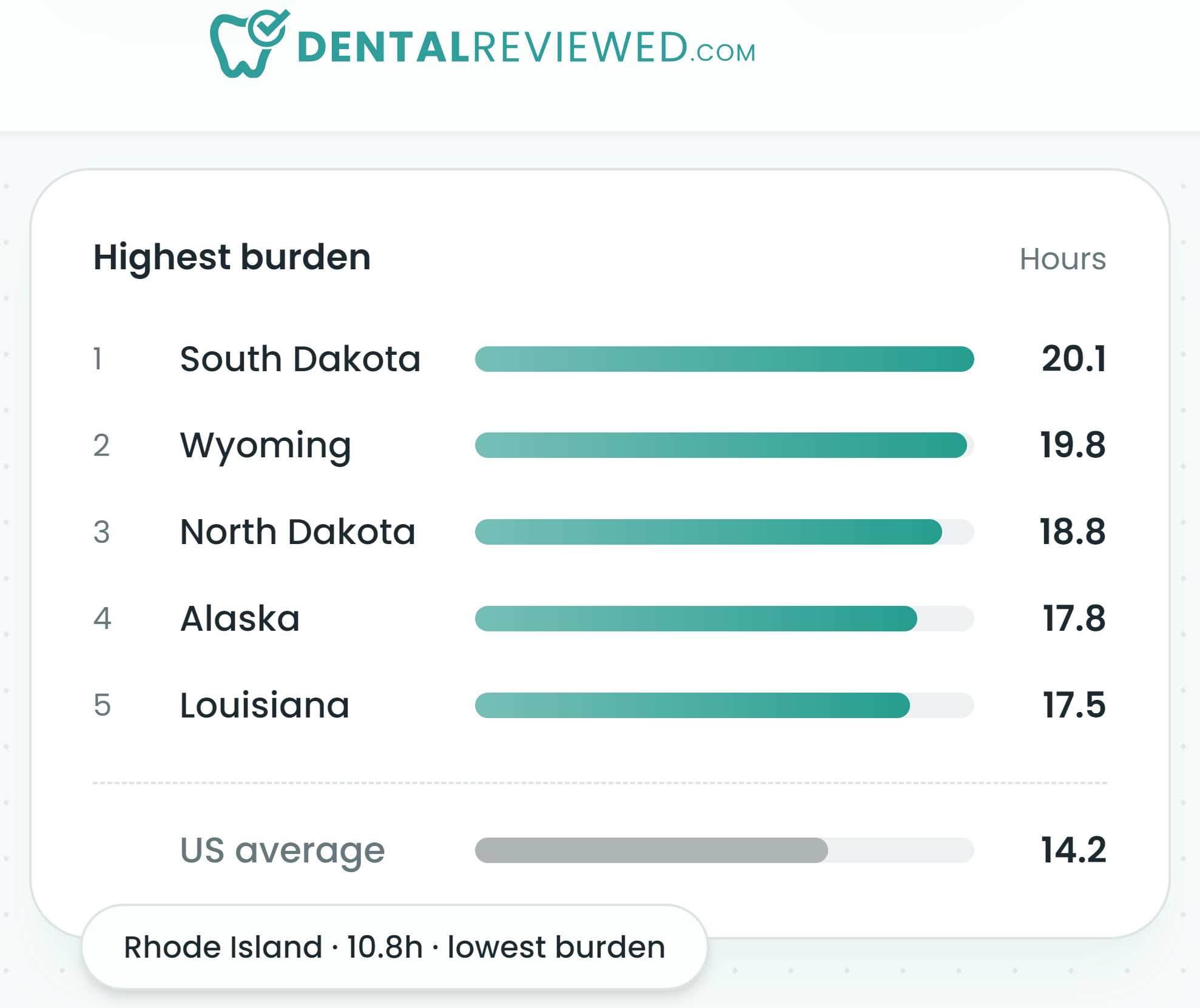
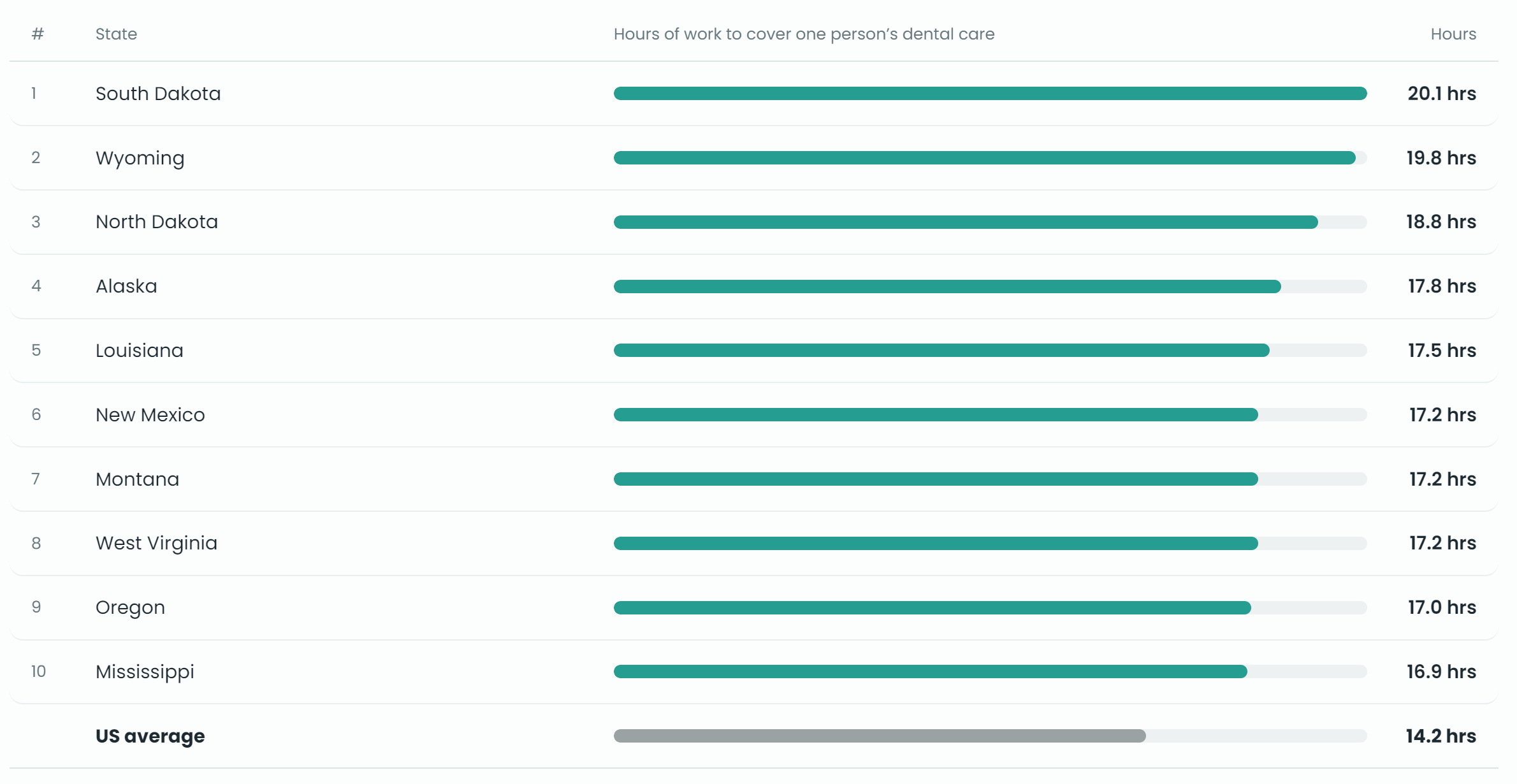
In terms of state rankings, South Dakota has the highest dental spending burden, with covering one person's annual dental costs requiring 20.1 hours of household work time; Rhode Island has the lowest at 10.8 hours, a difference of 9.3 hours between the two states.
The top 10 states with the highest required work hours are, in order: South Dakota 20.1 hours, Wyoming 19.8 hours, North Dakota 18.8 hours, Alaska 17.8 hours, Louisiana 17.5 hours, New Mexico 17.2 hours, Montana 17.2 hours, West Virginia 17.2 hours, Oregon 17.0 hours, and Mississippi 16.9 hours.
The bottom 10 states are: Rhode Island 10.8 hours, Maryland 11.0 hours, Hawaii 11.3 hours, Texas 11.5 hours, New Jersey 12.0 hours, Nebraska 12.0 hours, Ohio 12.6 hours, Pennsylvania 12.9 hours, California 12.9 hours, and Missouri 13.0 hours.
Per capita dental spending and affordability are not fully synchronized. For example, Mississippi's per capita dental spending is $489, which is $311 lower than Massachusetts' $800, but the corresponding household work hours are 16.9 hours, higher than Massachusetts' 13.5 hours, with the former about 25% higher than the latter.
Looking at per capita dental spending alone, New Hampshire has the highest at $929, but due to the relatively high local income level, its corresponding household work hours are 16.6 hours, ranking 12th among the 50 states rather than being the most burdened state.
Texas has a per capita dental spending of $487, among the lowest levels across states, with corresponding household work hours of 11.5 hours, ranking 47th among the 50 states. Dental Reviewed noted that Texas has a high uninsured rate, so lower dental spending does not necessarily mean dental services are cheaper—it may also be related to some residents reducing or forgoing dental services.
Additionally, Dental Reviewed noted that the index reflects the relative burden of dental spending against local household income. Therefore, simply comparing per capita dental spending cannot directly determine whether a state's dental services are more "affordable"; income levels also affect the final ranking.
| About DGN:DentalGoodNews (DGN) is a trusted professional media platform dedicated to the global dental industry. We deliver in-depth coverage of corporate news, policy & regulation, investment & funding, and clinical frontiers — serving dental institutions, device manufacturers, investors, and industry researchers worldwide. Contact us: haodeya@dongxizixun.com |

;)