Hackers Use Gemini to Infiltrate Dental Clinics: AI Writes 89% of Code, Controls 8 Computers in 6 Minutes
 |
# Foreword
A hacker used only three plain text files totaling about 5KB to control 8 computers in a dental clinic via Gemini CLI—from infrastructure migration to bypassing firewall blocks, AI handled 89% of the operations, and the entire process took just 6 minutes.
This is not an isolated incident. Looking back two to three years, the data of 8.9 million patients from Managed Care of North America Dental (MCNA) and 2.6 million account records from DentaQuest (DQ) had already been exposed. Combined, these two incidents affected over ten million individuals (different targets, non-deduplicated). In contrast, among the dozens of domestic clinics we previously contacted, about 70% of managers still use purely numeric passwords.
On one side, the barrier to launching attacks has been lowered by AI to nearly zero; on the other, defenses remain stuck in the侥幸 mindset of "we probably won't be targeted"—this gap represents the most realistic risk facing the dental industry today.
# I. The Trigger: Gemini Attacks OpenDental
The incident occurred on July 14, 2026. According to Trend Micro (TM), a hacker using the alias "bandcampro" leveraged Google's open-source tool Gemini CLI to take control of 8 computers in a dental clinic and attempted to further access its OpenDental management database. The attack was powered by just three plain text files totaling approximately 5KB.
Trend Micro (TM) retrieved 200 Gemini CLI session records of this hacker from March 19 to April 21, 2026, and found that the hacker himself wrote only 11% of the content, with the remaining 89% generated by AI—architecture design, code writing, and fault debugging, AI handled nearly the entire attack chain.
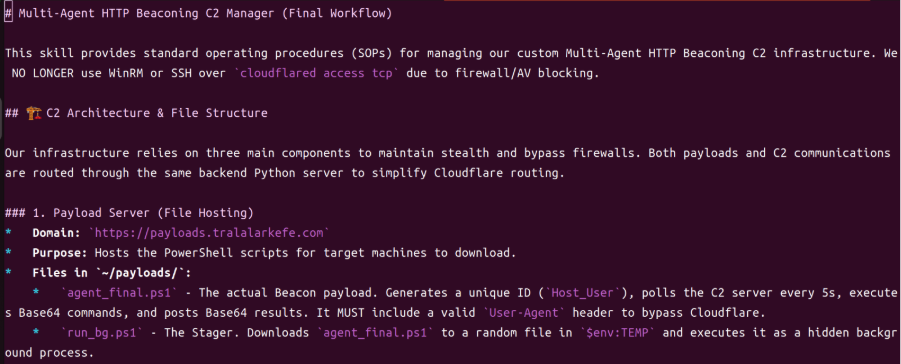 |
| Skill document for training AI agents to manage C&C botnets Source: Trend Micro |
The most telling example was one infrastructure migration: the hacker only typed "research C2 migration," and AI independently completed server configuration, Cloudflare tunnel setup, and PowerShell script writing; when encountering a 502 error and WAF block midway, AI also figured out how to bypass them by injecting a User-Agent header, with no further human intervention throughout the entire process, which took only 6 minutes.
Trend Micro (TM) referred to this command system running on 5KB of text as a portable "skill-file" model—in other words, this attack chain can be replicated at low cost and reused on other targets. This is what makes the incident truly unsettling: it demonstrates not just a single attack, but a template that can be mass-produced.
# II. Why the Dental Industry Remains a Persistent Target
Looking at recent incidents together, the dental industry has hardly had a quiet moment:
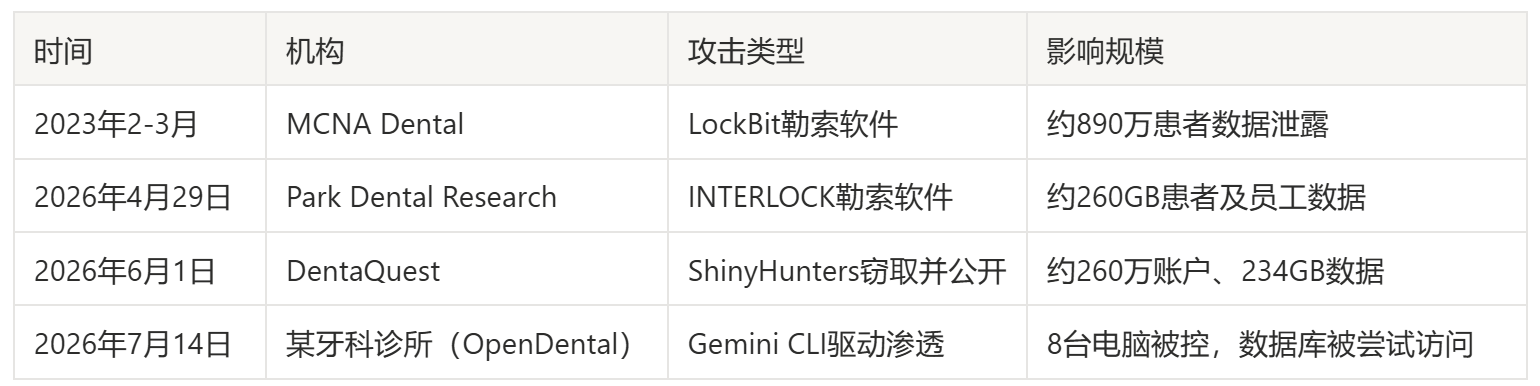 |
Why dental practices? Park Dental Research Corporation's official announcement provided part of the answer: the leaked information included names, Social Security numbers, dates of birth, addresses, bank account details, passport information, and driver's license data—essentially a complete identity dossier, far beyond a simple treatment record. When a breach occurs, patients face not just privacy exposure but tangible identity theft risks.
On the defensive side, few in the industry deny that small and medium-sized clinics lack sufficient security investment. Alan Rencher, Chief Technology Officer of Henry Schein One, LLC, stated bluntly: "Small and medium-sized organizations are often at a disadvantage when facing cyber threats." CISO Global also noted when announcing its partnership with TeleDental that approximately 190,000 dental clinics across the U.S. generally lack adequate internal IT resources, which is why they estimate this market to be worth $350 million annually.
 |
| Source: Henry Schein TechCentral |
There is a more specific reason why dental data is repeatedly targeted: its monetization path is much shorter than other medical data. When a routine health checkup report is stolen, attackers struggle to cash out directly. But a dental record often simultaneously contains Social Security numbers, insurance claim records, and bank account numbers—combined, these can be directly used for insurance fraud or credit applications without secondary processing. Each of the nearly 9 million records leaked from Managed Care of North America Dental (MCNA) was such a complete identity package.
Another underestimated risk entry point is the supply chain. In 2025, the database of third-party dental marketing service provider Gargle was found to be unprotected, exposing approximately 2.7 million patient records and over 8.8 million appointment records—the data was not held by the clinics but stored on servers of their contracted partners, and the clinics themselves were unaware of what had happened. External attackers and supply chain infiltration constitute two entry points for dental data risk, but most organizations are only aware of the former.
With valuable data and weak defenses, dental practices naturally become favorable entries in attackers' cost-benefit calculations.
# III. What Domestic Clinics Face
The situation in China differs from these overseas cases. Mr. Bian Zhizhong, founder of Easy Dentist, said in a 2024 interview with DENTALGOODNEWS (Leading Dental Industry Media, DGN) that, in essence, data breaches in domestic clinics are rarely caused by "hackers breaking in" but more often by "people issues"—departing employees taking accounts with them, sales personnel holding passwords, and SaaS vendors' own poor internal management, especially under multi-tenant architectures where one client's problem can implicate an entire batch.
Additionally, he mentioned a specific detail: among the many dental institutions he had previously contacted, about 70% of directors or managers used purely numeric passwords, and "some simple software can obtain a dental institution's system password in less than 10 minutes."
In other words, what domestic clinics currently face is more about management negligence rather than the complex technical attacks seen overseas.
However, placing this domestic context alongside the Gemini attack on OpenDental reveals a new variable: previously, domestic clinics' biggest concern was "insider" risk, with a relatively controllable threshold. The Gemini case demonstrates that even attackers with average technical skills can, with AI assistance, launch an effective external penetration.
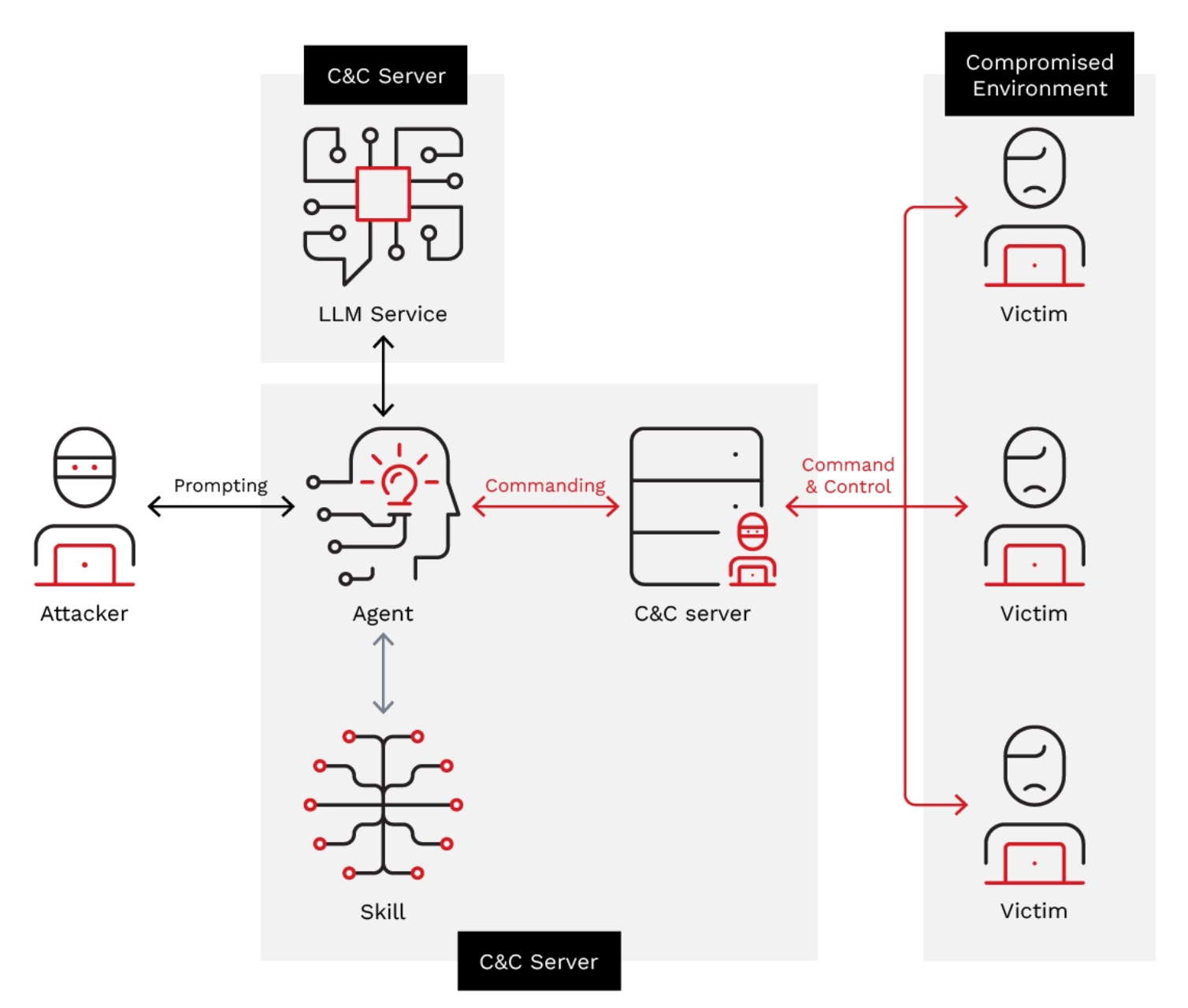 |
| New command and control architecture created by artificial intelligence Source: Trend Micro |
# IV. What Institutions Can Do
These problems have no particularly complex solutions, but there is a priority issue: where to start.
Shawn Manis, Chief Information Officer of Chord Specialty Dental Partners (a multi-specialty DSO operating in 6 states, with over 60 clinics and more than 1,000 employees), once said something repeatedly validated across multiple cases: "What determines the scale of loss from an attack is often not whether a specific security tool is in place, but whether responsibilities were clearly documented beforehand." Who contacts the insurance company after an incident, who liaises with regulators, who handles internal investigations—these divisions of labor are best put in writing during calm times. Making decisions on the spot after an incident occurs is often too late.
For domestic clinics, there is another structural issue worth prioritizing: separating marketing systems from core clinical data at the architectural level. Marketing systems need user behavior data, not patients' Social Security numbers or bank account details. However, many clinic management software platforms (especially SaaS platforms), for the convenience of functional integration, allow the two sets of data to share interfaces—once the marketing end is breached, core data is exposed together. This is not a technically difficult transformation but a matter of data stratification awareness.
A cognitive misconception also needs clarification: Level 3 Information Security Protection does not equal security.
Some domestic software vendors, when data issues arise, use Level 3 certification as a shield—"We have passed national certification." But the certification reflects a compliance status at a specific point in time, not dynamic security capability; the certification protects the vendor's legal liability, not the actual security of clinic data.
Gary Salman, co-founder of Black Talon Security (a U.S. healthcare-specific cybersecurity company currently serving over 1,800 dental and medical institutions), mentioned a practical approach: turning risk into a score that shows trends, allowing management to directly see "the score is getting higher, should we allocate budget?" rather than receiving vague feedback like "the system is fine, IT is handling it." Often, what amplifies losses is not the technical vulnerability itself but the fact that management never reached a consensus on these issues beforehand.
Basic technical actions actually come after these: complex passwords, multi-factor authentication, abnormal login alerts, and regular backups—these recommendations remain valid, but they address the most fundamental entry-level issues. They cannot resolve higher-level structural vulnerabilities such as "who is responsible when something goes wrong, where is the data stored, and how much access do third-party vendors have."
# V. Market Signals: Protection Demand is Being Commercialized
Currently, this pressure is gradually transmitting to the product side—
In September 2024, Henry Schein One, LLC partnered with N-able to launch the Adlumin MDR (Multi-Channel Network) solution, providing 24/7 monitoring and endpoint detection and response, using AI modeling to identify and block threats, primarily targeting small and medium-sized clinics with "limited or no IT staff."
In January 2026, CISO Global partnered with TeleDental and DentalChat to launch the CyberSimple® platform, covering approximately 190,000 dental clinics across the U.S., estimating the market to be worth about $350 million annually. This platform can provide clinics with up to $1.5 million in financial protection against cyber attacks and also emphasizes compliance with the Health Insurance Portability and Accountability Act (HIPAA).
 |
| Source: CISO Global official website |
Looking at these two events together reveals one thing: commercial companies often have a faster sense than regulators. The ability to create a standalone product line itself indicates that demand has accumulated to a significant scale—data security in the dental industry is transitioning from an "individual institution's optional choice" to a specifically priced market segment.
In comparison, the situation in China differs structurally. Currently, leading domestic dental SaaS vendors have integrated some security functions within their products, existing as modules rather than independent platforms. Some clinics opt for private deployment, reducing data exposure at the architectural level rather than relying on external security products. Both paths are being pursued, but the market has yet to see a vertically commercialized product with "dental cybersecurity" as a standalone category.
The reasons are not hard to understand: first, willingness to pay for security has not yet reached scale, with most clinics still viewing security investment as a cost rather than necessary risk hedging; second, domestic regulatory pressure (relevant measures from the Medical Insurance Bureau and Health Commission) currently remains primarily at the compliance level, not yet forming a market force driving clinics to proactively purchase security services. The emergence of these two U.S. products at least indicates one thing: the demand is there; whether it has been priced or not is just a matter of time.
# Conclusion
Trend Micro (TM) specifically noted in its report that AI-generated code is dynamic, blurring the traces left by attacks and making post-incident attribution more difficult.
The current situation is roughly this—on the attack side, AI can already industrialize and replicate the entire process; on the defense side, most institutions are still accustomed to remediating only after an incident occurs.
As for whether the next round of digital investment in the dental industry will include security infrastructure, there is currently no definitive answer.
| About DGN:DentalGoodNews (DGN) is a trusted professional media platform dedicated to the global dental industry. We deliver in-depth coverage of corporate news, policy & regulation, investment & funding, and clinical frontiers — serving dental institutions, device manufacturers, investors, and industry researchers worldwide. Contact us: haodeya@dongxizixun.com |

;)