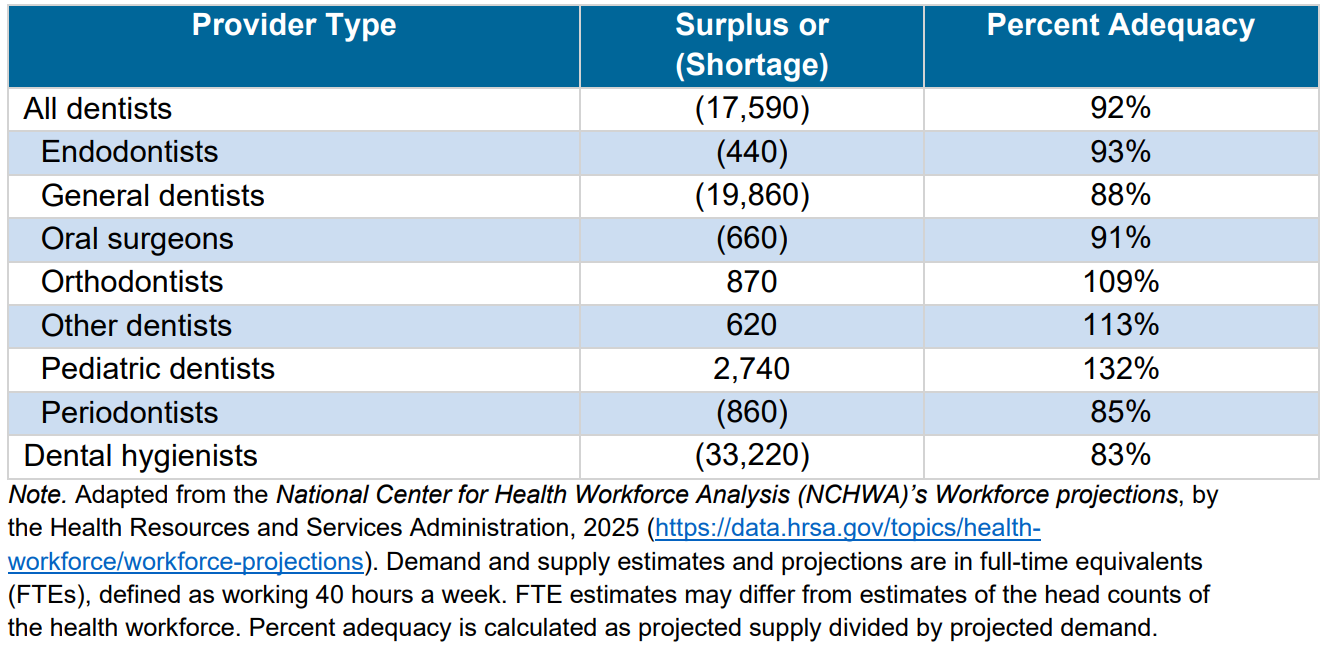
All U.S. states have granted dental hygienists anesthesia privileges, with the profession projected to face a shortage of over 33,000 in the U.S. by 2038.
 |
| Source: State of the U.S. Health Care Workforce, 2025 |
DentalGoodNews|Recently, a workforce forecast released by an agency under the U.S. Health Resources and Services Administration (HRSA) shows that the dental hygienist shortage crisis in the United States continues. The report projects that by 2038, the full-time equivalent (FTE) shortfall will reach 33,220. Meanwhile, the Governor of Delaware signed Senate Bill 131 (SB 131) on August 25, 2025, allowing dental hygienists to administer local anesthesia under the direct supervision of a dentist, with the bill officially taking effect on January 1, 2026. According to the relevant agency, Delaware became the 50th state in the nation to grant this authority, marking a unified expansion of this scope of practice across the United States.
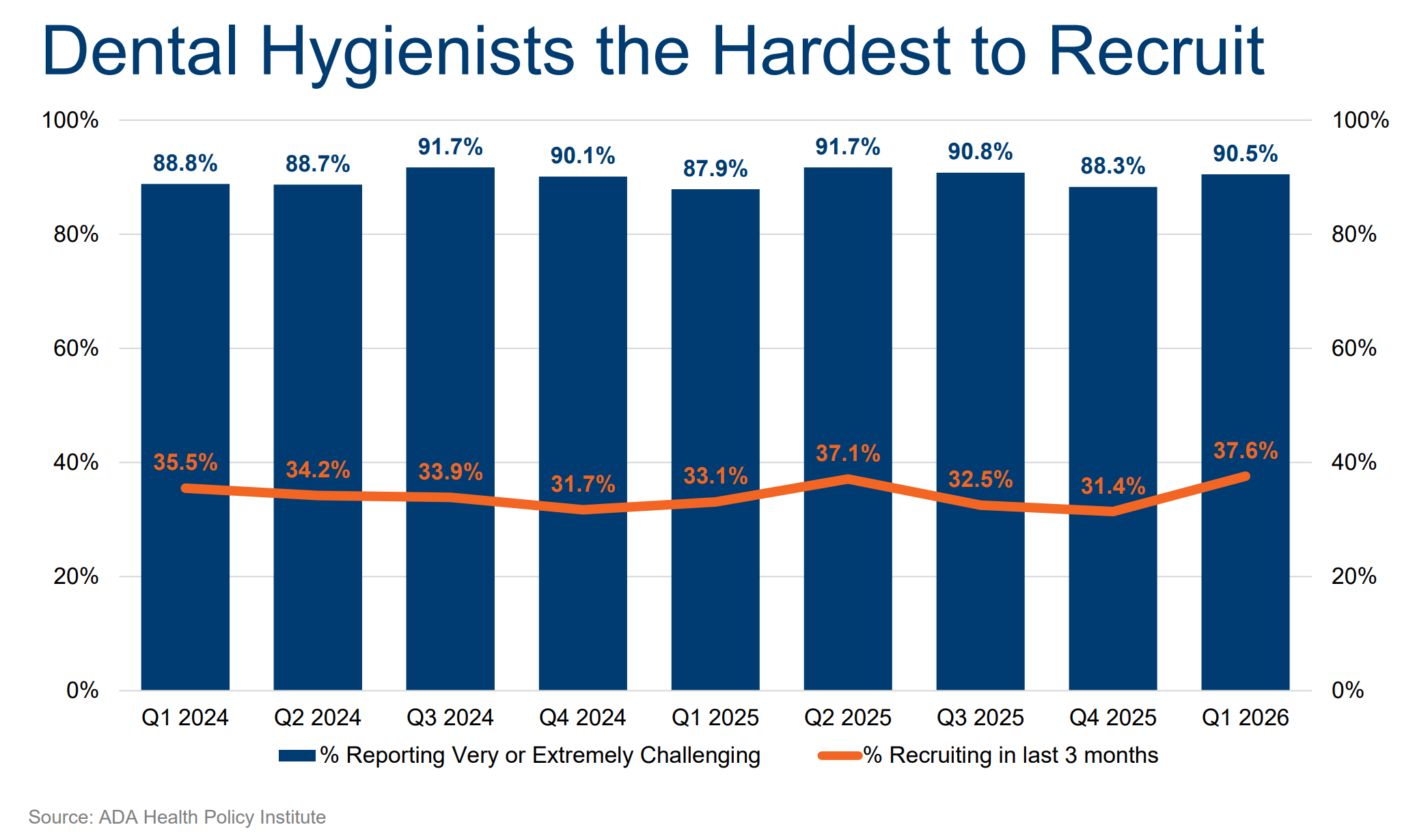
Currently, staffing in the U.S. dental industry faces multiple challenges. An analysis released by the American Dental Association Health Policy Institute (ADA HPI) in April 2026 shows that only 60% of dentists report having sufficient hygienist staffing, while among dentists currently hiring, approximately 91% report that the recruitment process is "extremely or very challenging." Research by dental finance company Sunbit further indicates that about 20% of job vacancies take more than six months to fill; the organization also notes that workforce attrition and burnout during the pandemic are continuing to intensify pressure on industry talent replenishment.
 |
| Source: American Dental Association Health Policy Institute |
Shortage pressure is forcing clinics to restructure their operating models. Data shows that about 31.4% of practicing dental hygienists plan to retire within five years; at the same time, 24.7 million Americans currently live in dental care shortage areas, with gaps in rural areas particularly prominent. To address the crisis, in addition to compensation competition, state laws are also accelerating adjustments. According to previous reporting by DGN, Utah has allowed hygienists to practice independently in hospitals. At the same time, states are actively joining the "Dentist and Dental Hygienist Compact" (DDH Compact). As of May 2026, 13 states, including Nebraska and Oklahoma, have joined the compact, allowing license holders to practice across state lines without additional licensure applications.
On the economic front, dental clinics are experiencing a "financial squeeze." The ADA report notes that due to inflation, the real wages of dental staff have declined in recent years, while clinic operating costs have risen and revenue has come under pressure. Sunbit's analysis suggests that clinics can improve efficiency by adopting technologies such as AI-assisted diagnosis and teledentistry, and by redesigning workflows to maintain productivity under staffing constraints.
| About DGN:DentalGoodNews (DGN) is a trusted professional media platform dedicated to the global dental industry. We deliver in-depth coverage of corporate news, policy & regulation, investment & funding, and clinical frontiers — serving dental institutions, device manufacturers, investors, and industry researchers worldwide. Contact us: haodeya@dongxizixun.com |

;)