New Study: Ti Alloy-Zirconia Two-Piece One-Piece Dental Implant, Expected to Reduce the Number of Surgical Interventions.
 |
| Source: Ministry of Science and Technology, India |
DentalGoodNews|On September 8 local time, the Department of Science and Technology (DST) of India announced that its subordinate research institution, the International Advanced Research Centre for Powder Metallurgy and New Materials (ARCI), has developed a novel two-layer one-piece dental implant. The implant features an integrated structure of titanium alloy (Ti6Al4V) and yttria-stabilized zirconia (YSZ), designed to overcome the stability issues associated with traditional multi-component systems and potentially reduce the number of surgical interventions required for implant treatment. The related research findings were previously published in the materials science journal "Materials Letters".
According to DST, traditional dental implant systems typically consist of three components: the implant fixture, the abutment, and the dental crown. This multi-component structure is prone to micromotion at the abutment interface, which may affect osseointegration and lead to implant loosening. Additionally, such systems generally require two to three surgical interventions, increasing patient discomfort and clinical complexity.
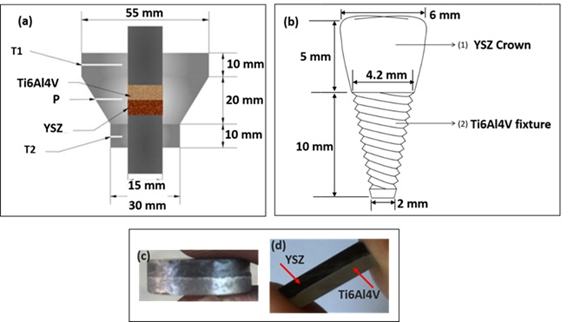
To address these issues, researchers at ARCI utilized spark plasma sintering (SPS) technology to develop a functionally graded two-layer one-piece structure. In this configuration, the lower Ti6Al4V layer serves as the load-bearing implant fixture and achieves osseointegration with the jawbone, while the upper YSZ layer forms the crown region, providing favorable wear resistance and aesthetic outcomes. The research team employed a customized tapered graphite mold to precisely control sintering temperatures across different regions, enabling the two materials with significantly different sintering temperatures to achieve dense bonding in a single step, with material density reaching 99.5%.
Following sintering, the research team further conducted thread implant machining trials using a 5-axis CNC machine. However, challenges remain regarding tool movement during curved surface machining, and process optimization is currently underway.
Mechanical property evaluations revealed that the two-layer structure achieves a maximum hardness of 1350 HV, compressive strength of approximately 1550 MPa, and flexural strength of approximately 310 MPa. These indicators are comparable to or higher than those of commercially available implant materials. Microstructural analysis showed tight interfacial bonding between the titanium alloy and zirconia, with no cracks, delamination, porosity, or secondary phases observed, nor any significant elemental diffusion, demonstrating favorable metal-ceramic interfacial bonding performance.
Regarding biocompatibility, in vitro experiments were conducted using L929 mouse fibroblasts with MTT assays. Results showed that cell metabolic activity exceeded 90% at all tested concentrations, surpassing the minimum threshold relevant to biomaterials. Furthermore, hemolysis tests indicated negligible damage to red blood cells, further supporting the material's biocompatibility for dental applications.
The researchers noted that this two-layer one-piece design has the potential to reduce the number of surgical interventions required for implant treatment and lower clinical treatment complexity. The research team is currently continuing process optimization and requires further studies to validate long-term implantation performance and scalability for manufacturing. Additionally, DST stated that the manufacturing process demonstrates high repeatability and holds potential for further expansion to industrial-scale production, though it currently remains in the process optimization stage.
| About DGN:DentalGoodNews (DGN) is a trusted professional media platform dedicated to the global dental industry. We deliver in-depth coverage of corporate news, policy & regulation, investment & funding, and clinical frontiers — serving dental institutions, device manufacturers, investors, and industry researchers worldwide. Contact us: haodeya@dongxizixun.com |

;)