As regulations on dental curing lights tighten, clinics should ask suppliers these 5 questions before purchasing.
 |
Preface
On September 2, 2026, the U.S. Food and Drug Administration (FDA) simultaneously published two final guidance documents in the Federal Register: "Dental Curing Lights — Premarket Notification [510(k)] Submissions" and "Dental Composite Resin Devices — Premarket Notification [510(k)] Submissions," replacing the previous versions from 2006 and 2005, respectively.
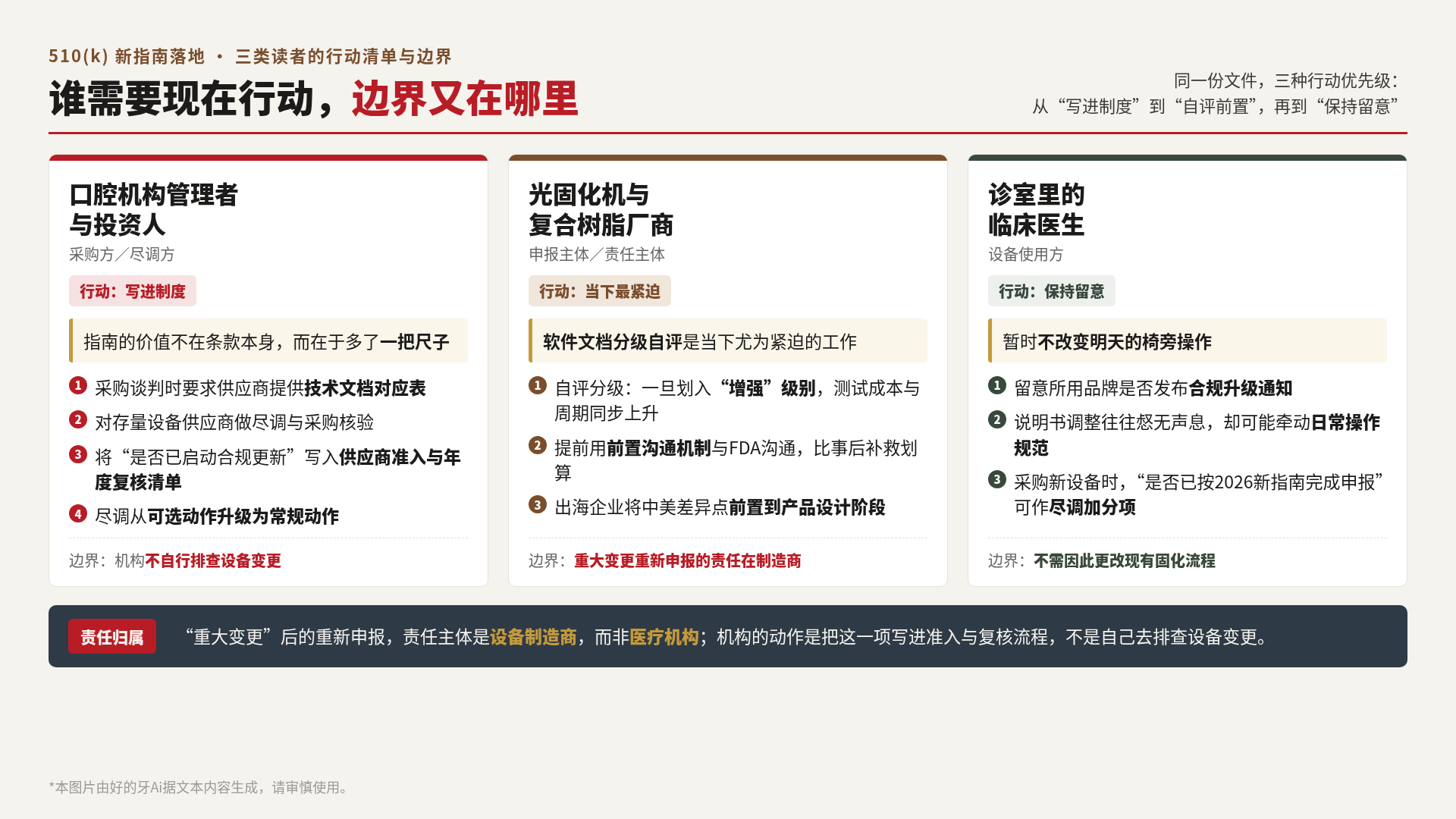
This marks the first systematic technical review revision in this field in nearly two decades. For dental curing light and composite resin manufacturers, this means that software documentation classification and cybersecurity documentation have entered the submission checklist for the first time; for oral care institution managers, suppliers' compliance maturity can now be written into the evaluation dimensions of procurement and investment due diligence; for most clinicians, this guidance does not change tomorrow's chairside operations for now — what will change is only the compliance upgrade notices that device brands may subsequently issue.
Almost simultaneously, China's National Medical Products Administration also released the mandatory standard YY 0055—2026 "Dentistry — Dental Curing Lights," scheduled to take effect on August 1, 2029. The more accurate description of "simultaneously" here is that the directions are similar, rather than institutional coordination or same-day implementation — the Chinese standard will not formally take effect for another three years, while the FDA documents correspond to the immediate expectations for current U.S. 510(k) submissions. The two differ in timing, legal effect, and review pathways.
The more practical question than the provisions themselves is: whose costs and responsibilities have they changed?
Not Just Whether the Light Is Bright Enough
Clinic managers, procurement staff, and clinicians are affected differently, but the source is the same: the criteria for judging device "compliance" have changed, and with them, the parties and methods of engagement.
Over the past two decades, dental curing light submissions primarily focused on optical parameters such as light intensity and radiant power. The new guidance, for the first time, includes "software documentation classification" and "cybersecurity" in the mandatory checklist. In other words, whether a device is "compliant" will no longer depend solely on whether the light is bright enough, but also on whether it has Bluetooth or Wi-Fi, and whether its software functions have complete verification records.
For clinic managers and procurement decision-makers, the practical implication of this change is: suppliers' compliance maturity now has specific indicators for comparison for the first time, no longer just a vague promise of "we are a legitimate manufacturer." Chairside workflows will not change immediately; what may change is a line of fine print in the instructions for use.
The scope of the new regulations is also very specific: it only covers quartz tungsten halogen lamps and LED curing lights used chairside at 380–515 nanometers, excluding laboratory-use indirect restoration curing devices, as well as laser and plasma arc devices. Requirements for composite resin material manufacturers are more detailed — biocompatibility assessment endpoints have expanded from 3 for dental curing lights to 6, with an added 7-day continuous elution release curve test.
A boundary needs to be clarified: whether re-submission is required after a "significant change" is the responsibility of the device manufacturer, not the clinic or the dentist. This falls under the content of supplier qualification and annual review checklists, not a screening item in the clinic.
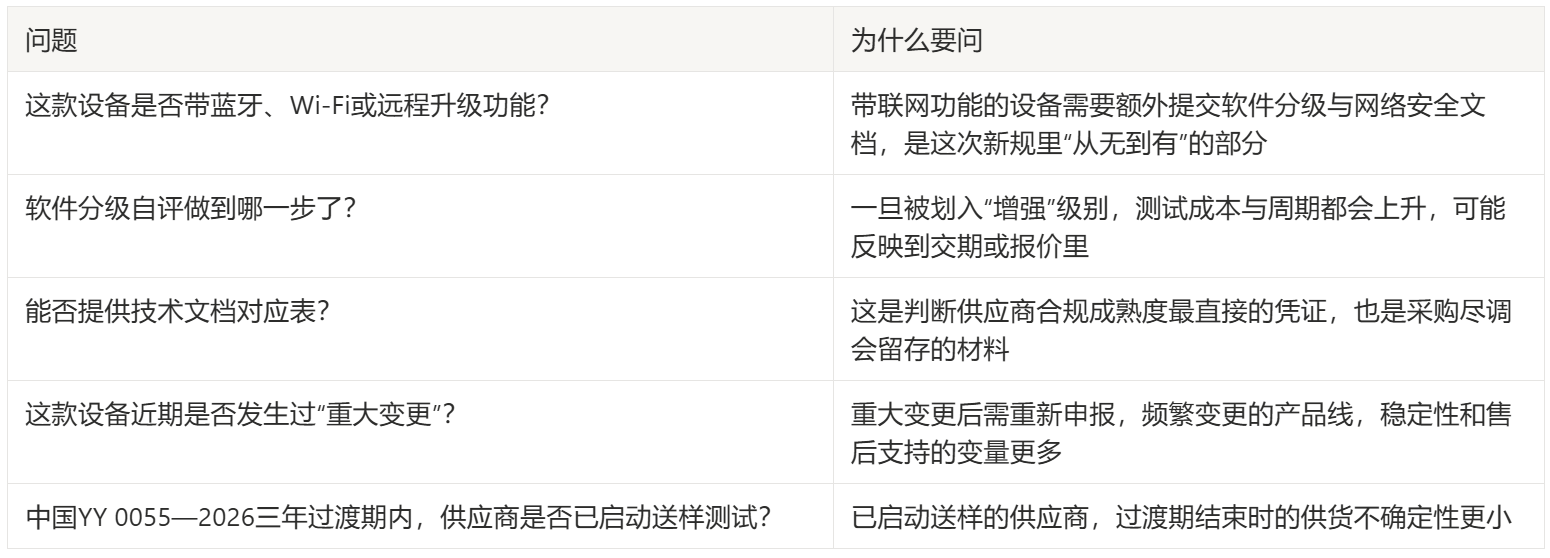
5 Questions Worth Having at the Negotiation Table
When the technical parameters in the guidance land in the procurement process, the usable form is a few specific questions.
 |
| Graphic: Good Teeth DataLab |
Not getting an answer does not equal non-compliance, but it means this item is missing from the due diligence materials. The answers to these 5 questions rest on the device's compliance foundation and also affect whether daily operations may be required to adjust in the future.
Two Sets of Data: Where the Tightening Signal Comes From
There is no publicly available commercial data that can distinguish dental chairside curing lights, dental laboratory post-curing devices, and industrial curing equipment. Therefore, this article does not cite any "dental curing light market size" figures, and only examines two side angles: upstream material volume and domestic registration structure.
Upstream Material Volume: Composite Resin Growth Outpaces the Overall Restorative Market
One indirectly referable measure is the upstream composite resin material market. According to Grand View Research data, the global restorative dentistry market was approximately USD 22.424 billion in 2024, projected to reach USD 34.896 billion by 2030, with a compound annual growth rate of 7.7% from 2025 to 2030; among this, composites, as an important sub-segment of direct restorative materials, had a market size of approximately USD 1.546 billion in 2024, projected to reach USD 2.644 billion by 2030, with a compound annual growth rate of 9.4% from 2025 to 2030. Composite growth has outpaced the overall restorative market.
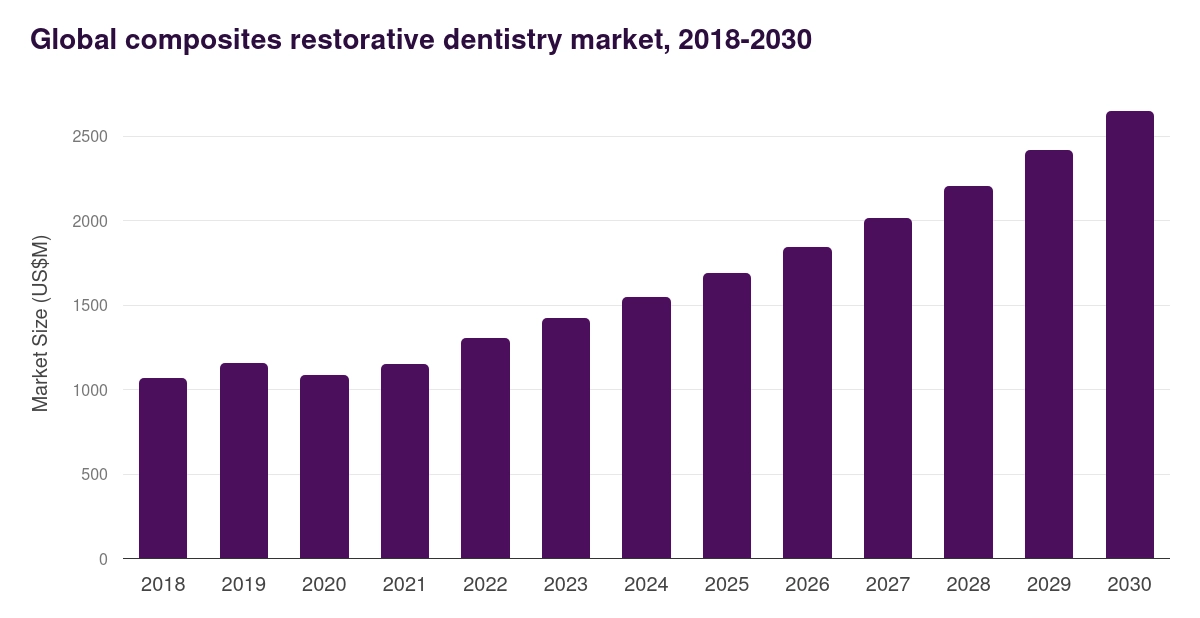 |
| Source: Grand View Research, "Global Composite Restorative Dental Market Statistics" |
These figures pertain to composite resin materials, not dental curing lights themselves — the latter are supporting equipment for the curing step of the former. The two markets cannot be converted into each other, nor can China's dental curing light sales be extrapolated from them. What they can indicate is only one point: the FDA revision this time addresses a major material category in dental restoration worth nearly USD 2 billion and still expanding, not a marginal category.
China Market: Registration Data More Reliable Than Commercial Reports
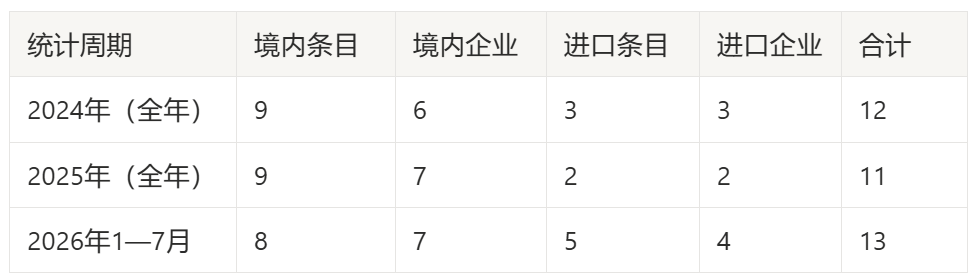
As a cross-validation of publicly available commercial reports, the oral medical device registration database tracked by DentalGoodNews DataLab provides another observation angle. Using product names containing "curing light" as the search criterion, the structure of new registration entries from January 2024 to July 2026 is as follows:
 |
| Data source: Good Teeth DataLab |
The absolute entry counts for the three periods are 12, 11, and 13, respectively — similar in magnitude. However, the three sets of figures cannot be directly compared horizontally: 2024 and 2025 are complete 12-month periods, while 2026 only includes data through July (the database's current collection boundary; August data has not yet been published). If converted to monthly averages, 2024 was 1.0 entries/month, 2025 was 0.92 entries/month, and the first seven months of 2026 was 1.86 entries/month — the change in imported entries is more pronounced, rising from 2 in 2025 to 5 in the first seven months of 2026, with the number of companies involved increasing from 2 to 4.
The annual sample size is only 11 to 13 entries, and these are only collected new registration entries, not equal to all valid registration certificates, nor do they reflect sales volume. Therefore, only the structure is examined here, not the trend.
Product structure is differentiating: new registrations have expanded from a single chairside filling material to multiple product lines including flowable resins, adhesives, as well as additive manufacturing crown and bridge resins, denture base resins, and artificial tooth resins. The regulatory target may have shifted from a single product to a product family. Imported companies increased from 2 in 2025 to 4 in the first seven months of 2026, and the available suppliers are increasing.
Product Boundary: Dental Curing Lights Are Not a Vague Broad Category
The first step in determining whether the new regulations apply is to clarify the boundary: YY 0055—2026 only applies to quartz tungsten halogen lamps and LED curing lights at 380–515 nanometers used for chairside curing of dental polymer-based materials, explicitly excluding laser and plasma arc devices, and also not applicable to dental laboratory curing lights used for indirect restorations, veneers, dental prostheses, and other oral devices. In other words, chairside LED curing lights are most likely within scope, while dental laboratory indirect restoration curing devices are not.
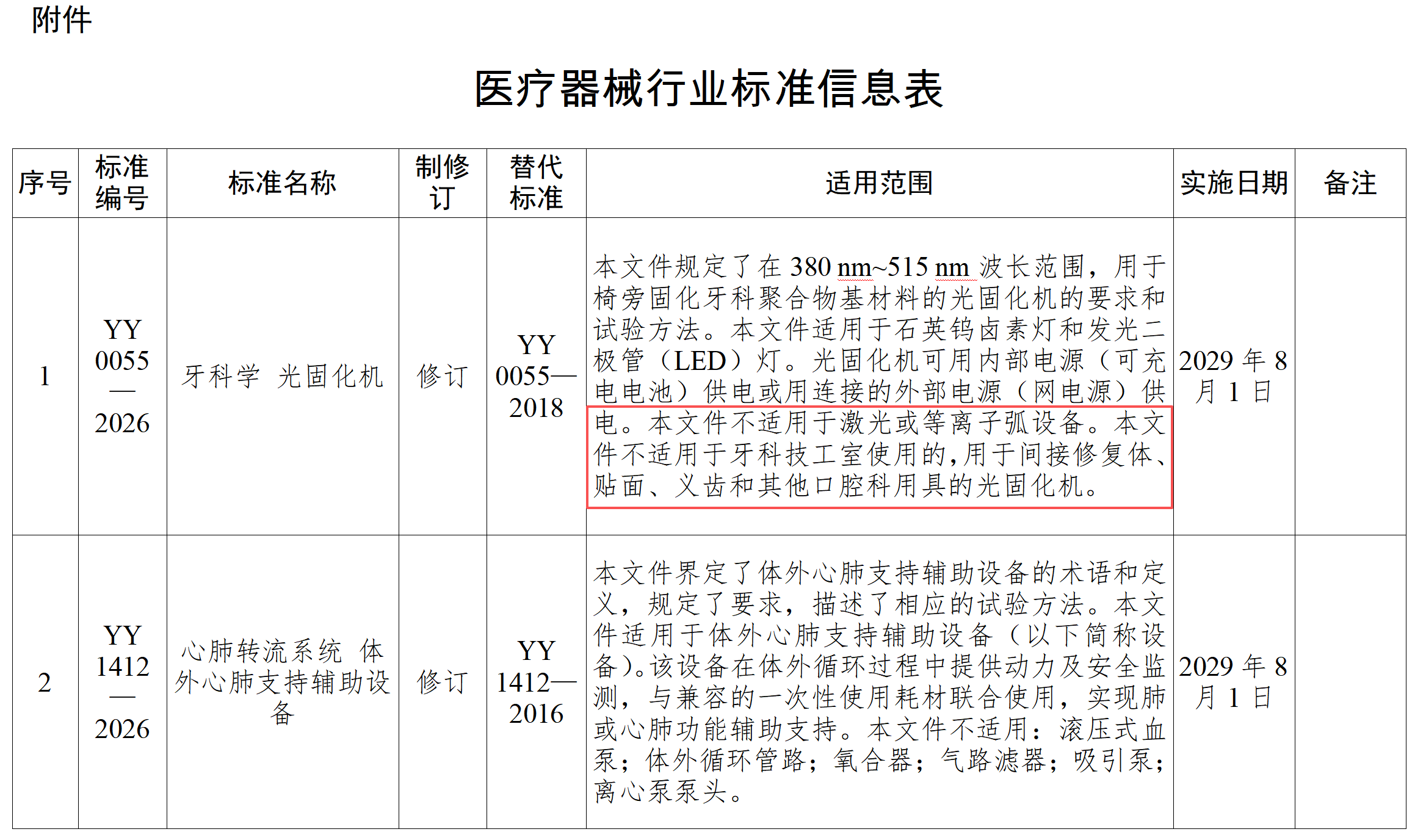 |
| Source: YY 0055—2026 Medical Device Industry Standard Information Table |
The Same Exam Paper, Four Types of Answers Differ Dramatically
"Dental curing light and composite resin manufacturers" are not a homogeneous group — the weight the new regulations place on them varies greatly.
The biggest difference is for device manufacturers with Bluetooth, Wi-Fi, or remote upgrade capabilities. The other categories face items that already had prototypes in the old guidance, with the new regulations merely being more detailed; only this category needs to build two sets of documentation from scratch — software classification and cybersecurity — which were completely absent from the old guidance. Moreover, this burden is not fixed: once software functions are classified as "enhanced" level, testing costs and timelines increase accordingly; if the device is further determined to be a "network device" as defined by regulations, cybersecurity documentation must be submitted separately. Among the four types of enterprises, this is also the one most likely to pass compliance burdens directly onto delivery times and quotations. Network connectivity is therefore the first question in due diligence — it determines the weight of the next four questions.
The checklists for the other three categories are much shorter. Ordinary non-networked LED device manufacturers still face optical performance, electrical safety, thermal risk, labeling, and comparative testing, with changes mainly in more detailed test items and disclosure granularity.
Traditional composite resin companies face ingredient disclosure, expanded biocompatibility endpoints (six items, double that of curing lights), and elution release curve testing.
Additive manufacturing resin companies also need to address system compatibility among materials, printing equipment, and post-curing parameters — such products have already appeared in batches in China's registration database, but this layer of impact is currently more of an industry chain inference. The compliance pathways for the first three types of enterprises can find direct basis in the two FDA guidances and YY 0055—2026, while the fourth type still needs more regulatory documents for corroboration.
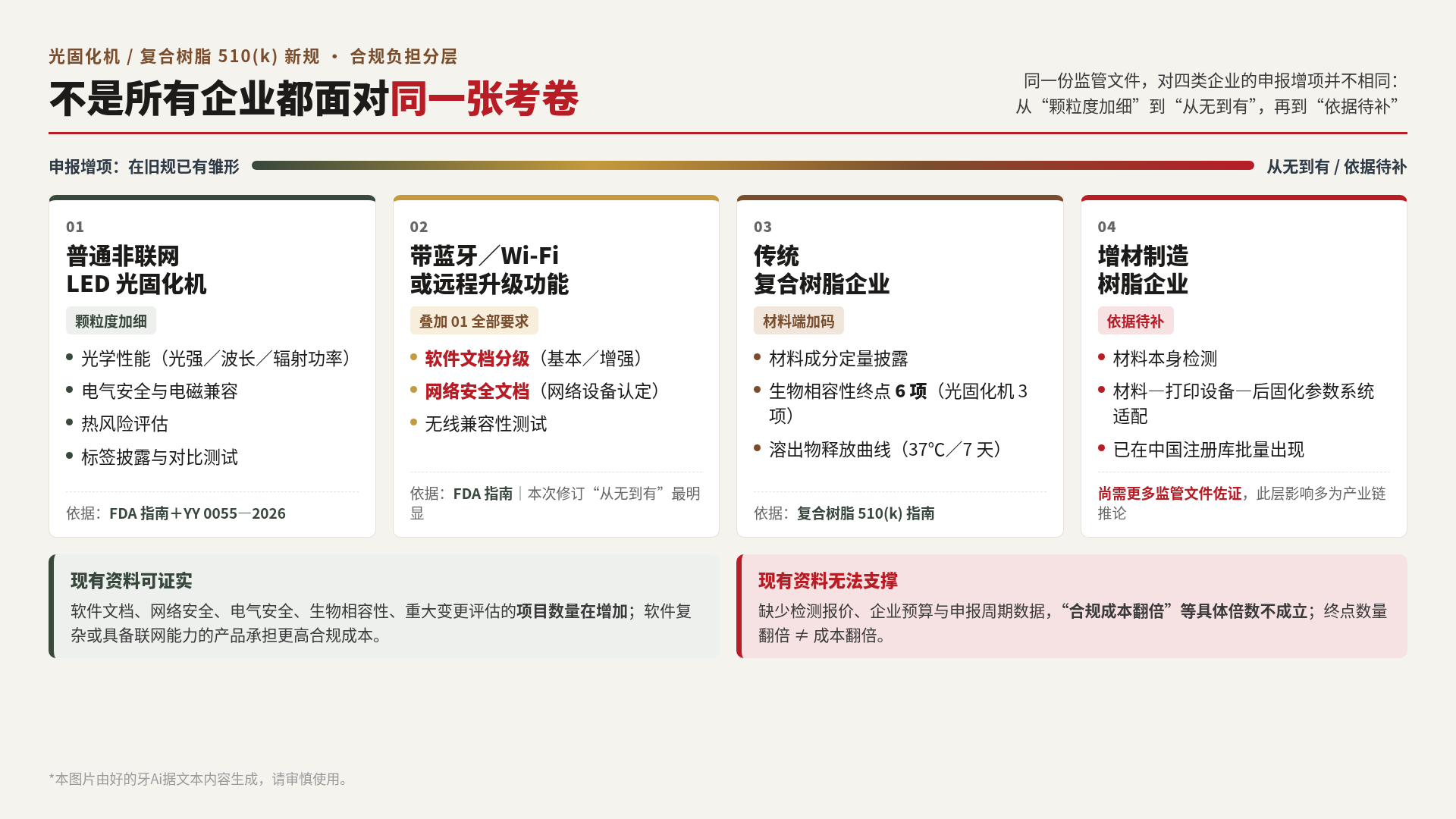 |
What is certain is that the number of items is increasing: software documentation, cybersecurity, electrical safety, biocompatibility, and significant change assessment, with products having complex software or network capabilities bearing a larger share. As for how much it will increase, there is no testing quotation, corporate budget, or submission timeline data to rely on, and "compliance costs doubling" cannot be traced in existing materials — composite resin biocompatibility endpoints are double those of curing lights, but this is only the number of endpoints, not a cost multiplier.
From Optical Parameters to Cybersecurity: What Has Changed
Over the past two decades, submissions for dental curing lights and composite resins largely relied on two old documents. At that time, wireless technology, device software functions, and cybersecurity issues had not yet entered the regulatory视野, and manufacturers' submissions focused more on physical parameters such as radiant power and light intensity. Whether software required separate documentation and whether network-connected devices required cybersecurity assessment had long remained in a blank zone.
The new guidance fills these gaps one by one for the first time. At the device description level, manufacturers need to provide a complete component list, internal engineering drawings, and light source parameters, and present a side-by-side comparison table showing the similarities and differences between the submitted device and a marketed comparison device in terms of light intensity, radiant power, peak wavelength, and other indicators. Labeling requirements are also more detailed: as a prescription device, dental curing lights can be exempted from the obligation to provide instructions for non-professional users, but must still disclose total radiant power, maximum light intensity, peak wavelength, recommended usage distance and angle, and other information.
The reprocessing and biocompatibility sections follow the previous assessment logic but with clearer requirements: reusable patient-contacting components must complete three endpoint assessments — cytotoxicity, sensitization, and irritation — according to ISO 7405 or ISO 10993-1 standards. The composite resin guidance goes further, expanding biocompatibility endpoints to six, double that of curing lights, and adding quantitative disclosure of material composition and elution release curve testing, requiring continuous measurement of cumulative release concentration over seven days at 37 degrees Celsius in 10 milliliters of distilled water.
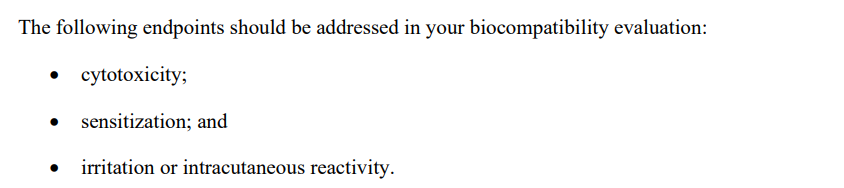 Updated Dental Curing Light 510(k) Guidance | 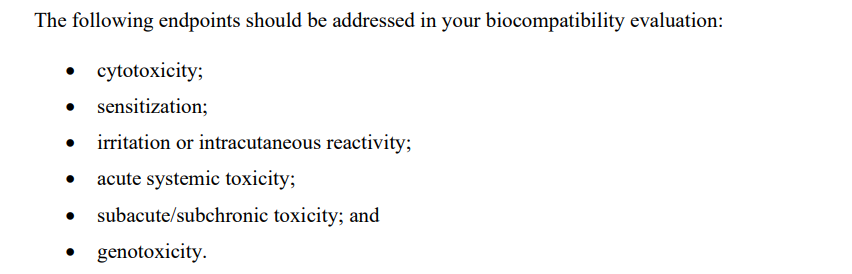 Updated Composite Resin 510(k) Guidance |
The truly "from nothing to something" part is software documentation classification and cybersecurity. The guidance requires manufacturers to determine the submission tier according to the corresponding documentation level standards. Most dental curing light software functions still fall under the "basic" level, but products involving new light sources or atypical indications may be classified as "enhanced" level, requiring more complete verification records. If the device is determined to be a "network device" as defined by regulations, cybersecurity documentation must also be submitted separately — such requirements never appeared in the old guidance.
The choice to publish the two guidances for dental curing lights and composite resins on the same day is not a coincidence of document organization. The two form a supporting system for chairside direct restoration — the curing light determines whether the resin can fully cure, and the resin's composition and curing characteristics in turn affect the device's light intensity and wavelength design. The FDA's bundled revision of the two is more like redrawing the review boundary according to actual clinical usage scenarios.
China and the U.S. Tightening Almost Simultaneously: The Same Variable Behind It
The direct variable driving this revision is the change in device form over the past two decades. When curing lights began integrating Bluetooth, Wi-Fi, and other wireless functions, and when software took on the role of controlling curing modes and output doses, the old guidance's silence on these capabilities shifted from a temporary gap to a real risk of disconnect between review standards and actual products. The new regulations require devices with integrated wireless technology to additionally complete compatibility testing and explicitly state that electrical safety and electromagnetic compatibility must follow the IEC 60601 series of standards — a direct response to this disconnect.
Almost simultaneously, China's National Medical Products Administration also released the mandatory standard YY 0055—2026 "Dentistry — Dental Curing Lights" in August 2026, standardizing light source types at 380 to 515 nanometer wavelengths and testing methods, scheduled to formally take effect on August 1, 2029. This standard and the new FDA guidance have clear overlap in disclosure requirements for light intensity, wavelength, and dose, but the pace is not the same: the new FDA regulations are considered current review expectations upon publication, while China has given a nearly three-year transition period. This difference is closer to independent choices of regulatory pathways rather than products of mutual reference — "China and the U.S. tightening simultaneously" describes similar directions, not the same system taking effect in both places at the same time.
The path of pressure transmission is asymmetric. For device companies, the first impact is software and electrical safety testing costs, especially for small and medium-sized manufacturers with newer software functions and lacking mature testing processes, who need to invest more resources to complete their documentation systems. This incremental cost may be reflected in device quotations, or may prompt some small and medium-sized manufacturers to exit or be acquired; as for whether industry concentration will accelerate as a result, existing materials cannot provide an answer. For material companies, the challenge is extended R&D and testing cycles brought by chemical composition disclosure and expanded biocompatibility endpoints, slowing new product launches.
What Will Change Now, and What Won't
The first thing to change is the instructions for use: revisions happen quietly but affect daily operating standards. When procuring new equipment, "whether the 2026 new guidance submission has been completed" is an item that can be directly compared between suppliers.
On the manufacturer side, the self-assessment of software documentation classification determines subsequent costs: once classified as "enhanced" level, testing costs and timelines increase accordingly, and the later the classification is confirmed, the narrower the testing window. For domestic companies planning to go overseas, whether to address the differences between Chinese and U.S. standards at the product design stage or wait until submission involves very different scopes of modification.
 |
This FDA guidance only governs submission requirements for the U.S. market and does not directly apply to registration within China, which still follows domestic review guidelines. During the transition period, the criteria for determining whether a "significant change" triggers re-submission still have ambiguous areas, and specific cases need to be judged individually, making simple application difficult. The trade-off between rising compliance costs and improved review efficiency places a more obvious burden on small, medium, and micro enterprises.
The FDA reminds that if devices under the two guidances undergo significant changes that may significantly affect safety or effectiveness, or constitute a major change in intended use, manufacturers must legally re-submit [510(k)] submissions. The granularity of regulation has changed, and the submission logic that sufficed over the past two decades will show blank items against the new checklist.
Conclusion
That line of fine print in the instructions for use is where this revision first lands before the clinic's eyes: total radiant power, maximum light intensity, peak wavelength, recommended usage distance and angle — which item is written in more detail than before, which item was never written at all. Behind this is the expansion of review granularity from optical performance to software documentation and cybersecurity.
Further down the line are those manufacturers who have installed Bluetooth and remote upgrade capabilities on their devices. The Chinese standard has left a three-year transition period, while the new FDA regulations are considered current review expectations upon publication. These two time gaps fall on the same product line, and delivery times and quotations may react first.
On the clinic side, the current change lands on one additional question in the procurement process: is this device network-connected?
| About DGN:DentalGoodNews (DGN) is a trusted professional media platform dedicated to the global dental industry. We deliver in-depth coverage of corporate news, policy & regulation, investment & funding, and clinical frontiers — serving dental institutions, device manufacturers, investors, and industry researchers worldwide. Contact us: haodeya@dongxizixun.com |

;)