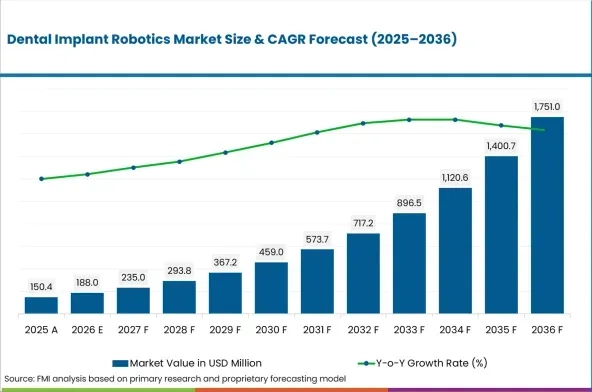
The dental implant robot market is projected to surpass $1.7 billion by 2036, with a compound annual growth rate of 25%.
 |
| Source: Dental Implant Robotics Market Report |
DentalGoodNews|In August 2026, Future Market Insights released the "Dental Implant Robotics Market Report," projecting that the global dental implant robot market will grow from USD 188 million in 2026 to USD 1.751 billion by 2036, with a compound annual growth rate (CAGR) of 25%. The continuous elevation of precision requirements for drilling path accuracy in implant surgery, coupled with the parallel iteration of supporting imaging and planning software, is identified as the primary driver of this growth.
This precision demand is directly reflected in the distribution of technology structures: in 2026, haptic-guided robotic arms with physical constraint capabilities are expected to capture 56% of the market share, surpassing dynamic navigation systems that rely on visual positioning without physical limits.
 |
| Source: Dental Implant Robotics Market Report |
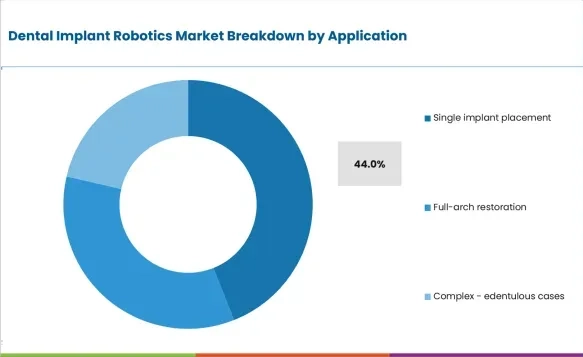
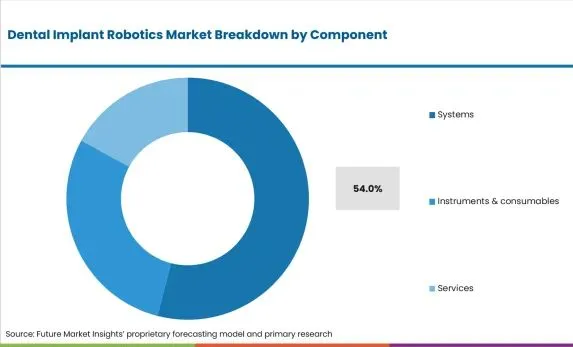
Among specific surgical procedures, single-tooth implantation, due to its relatively standardized workflow, is projected to contribute 44% of the market share, becoming the segment with the highest proportion. Correspondingly, complete systems comprising robotic arms, planning software, and patient tracking modules are expected to account for 54% of the total component value in 2026, indicating that clinic capital investment remains primarily directed toward integrated platforms rather than standalone consumables or software modules.
 |
| Source: Dental Implant Robotics Market Report |
The choice of technological pathways and investment structures demonstrates varying paces of advancement across regions: the United States leads with a projected CAGR of 26%, ahead of the European Union's 23%, a gap attributed to the commercialization efficiency advantages of the single federal FDA approval system, while decentralized regulatory and procurement decisions across EU member states prolong market penetration cycles. In the Chinese market, multiple enterprises have already established layouts along both robotic arm and marker-free navigation technology pathways. Additionally, policy developments on the pricing front emerged concurrently: according to previous reporting by DGN, the Guangdong Provincial Healthcare Security Administration issued a notice in April 2026, proposing a maximum price cap of RMB 1,033 per unit for 3D guides in dental implantation, with robotic-assisted operation fees permitted to be surcharged at up to 300% of the primary surgery price.
Setting aside regional and policy differences, surgical efficiency and equipment cost data equally influence the market penetration progress of robotic systems. Multi-center studies show that robotic-assisted surgery, compared to conventional techniques, reduces surgical time by approximately 45% in certain implant cases, with full-arch restoration cases averaging 80 minutes saved; correspondingly, equipment procurement and training costs remain the primary constraints on scaled adoption—the American Dental Association's Q2 2025 report indicates that a majority of surveyed dentists reported year-over-year price increases exceeding 5% for equipment and consumables during the first five months of that year.
| About DGN:DentalGoodNews (DGN) is a trusted professional media platform dedicated to the global dental industry. We deliver in-depth coverage of corporate news, policy & regulation, investment & funding, and clinical frontiers — serving dental institutions, device manufacturers, investors, and industry researchers worldwide. Contact us: haodeya@dongxizixun.com |

;)